CarboXtrem TT Aerobars
€890,00
CARBOXTREM
Pre-launches, custom-fit tips and offers for your bike. No spam: only what is worth it.
Already have an account? Sign in12/06/2026 · Alfonso Lopez Pe

Almost every mountain, gravel or marathon rider knows the feeling: you start the ride full of energy and, after a couple of hours, your fingers —especially the ring and little fingers— go numb, tingle and lose strength. You let go with one hand, shake it, grab the bar again… and ten minutes later, there it is again. Many people accept it as part of the price of spending hours on the bike. It isn't.
Numb hands are a sign that something —vibration, pressure or both— is punishing the nerves that run through your palm. And although position, gloves and bike fit all play a part, there's one contact point almost nobody checks that changes everything: the grip. That's where CarboXtrem's Race Day Grips come from.
Hand numbness on the bike has a classic name in the sports literature: cyclist's palsy. Behind it are two mechanisms that usually act together:
What irritates them? The weight of the upper body resting on a small point of the palm and, above all, the continuous vibration that travels up from the ground through the wheel, fork and handlebar to your hands. Every bump, every stretch of gravel or roots, is a micro-jolt repeated thousands of times per ride. That sustained vibration is what gradually "switches off" the nerve. Reducing it isn't a comfort luxury: it's what stops you getting home with fingers that stay numb for hours.
The traditional answer to the problem has been "add something soft": foam grips or grips filled with gel/silicone. They help at first, but they have a physical limit:
Gel adds weight and, once it shifts inside the cover, leaves areas unprotected. The underlying problem is the same: a solid material cushions once, but doesn't manage vibration intelligently.
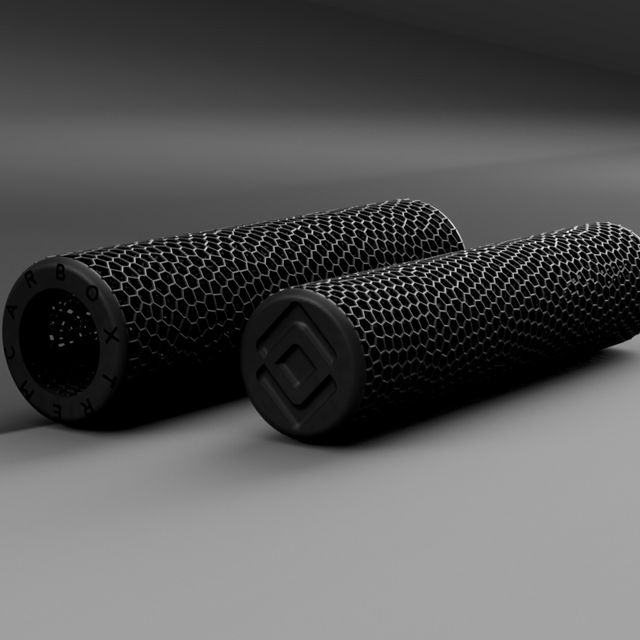
Race Day Grips aren't a grip with padding: they're a 3D-printed lattice structure. Instead of solid material, their surface is a Voronoi lattice made up of thousands of interconnected cells. And that's the difference: by playing with the thickness and size of each cell, the part can be soft where you put your weight and firm where you need grip and control, something impossible with a uniform foam.
They're made with Carbon's DLS (Digital Light Synthesis) technology —the same family of elite 3D printing we use for our saddles— in Loctite EPU 41 resin, an elastomeric polyurethane designed precisely to absorb vibration and recover its shape again and again without giving out. That combination of geometry + material is what allows CarboXtrem to state vibration absorption around 80% higher than foam or silicone grips.
One detail says a lot: Race Day Grips have been officially recognised by Carbon as a success story in the sports sector. It isn't our marketing: it's technology validated by the company that makes the machine itself.
Because the lattice is open, air circulates between the cells. That means less sweating and better grip in hot or humid conditions, where a closed rubber grip gets slippery. More control with less grip force translates, once again, into less fatigue and less pressure on the nerves.
| Feature | Detail |
|---|---|
| Construction | 3D-printed Voronoi lattice (not foam or gel) |
| Material | Loctite EPU 41 resin (elastomeric polyurethane) |
| Technology | Carbon DLS (Digital Light Synthesis) 3D printing |
| Vibration absorption | ~80% higher than foam or silicone grips |
| Weight | Ultralight (just a few grams per grip) |
| Ventilation | Open structure: reliable grip in heat and humidity |
| Recognition | Success story officially recognised by Carbon |
| Designed for | MTB, XCO, marathon, gravel and long rides |
| Manufacturing | Made in Spain · Lifetime warranty |
In terms of what you feel on the bike, switching to a 3D lattice grip means:
In a race or a long sportive, that difference isn't cosmetic: it means still braking and cornering precisely when others are already fighting numb hands.
Mainly because of compression of the ulnar and median nerves in the palm, combined with the continuous vibration coming up from the ground through the handlebar. The weight of the upper body on a small point and the repeated micro-jolts end up numbing the fingers. Reducing vibration and spreading pressure on the grip helps directly.
They have no solid filling: they're a Voronoi 3D lattice 3D printed in EPU 41 resin with Carbon DLS technology. Foam bottoms out and gives out; the lattice cushions, breathes and recovers its shape, with vibration absorption around 80% higher than foam or silicone.
Loctite EPU 41 resin (elastomeric polyurethane) printed with Carbon's DLS (Digital Light Synthesis), a high-precision 3D printing process that creates the Voronoi lattice structure at an ultralight weight. CarboXtrem is a success story recognised by Carbon.
For riders who train and race seriously in MTB, XCO, marathon or gravel and spend hours on technical or rough terrain, where vibration and numb hands take their toll. They're ultralight and ventilated, ideal for hot days and long rides.
If you invest in a good fork, wheels and position to ride more comfortably and faster, don't let the last link —the contact between your hand and the handlebar— be a piece of foam that gives up after two hours. Numb hands aren't the toll of long rides: they're a problem with a solution.
Topics