CarboXtrem TT Aerobars
€890,00
CARBOXTREM
Pre-launches, custom-fit tips and offers for your bike. No spam: only what is worth it.
Already have an account? Sign in07/07/2026 · Alfonso Lopez Pe

Every MTB or e-bike rider knows the scene: it's raining or the mud is flying, your glove gets soaked and suddenly every bump is a small struggle not to lose your hand off the handlebar. Instinct says "I need better gloves". But half of the equation —the half almost nobody checks— is underneath: the grip.
Grip is a two-surface system. On top, the palm of the glove. Underneath, the surface of the grip. When that surface is smooth rubber or foam, water forms a continuous film between glove and grip, and the friction coefficient plummets. We squeeze harder to compensate, the forearm gets loaded, fatigue sets in… and with fatigue come mistakes.
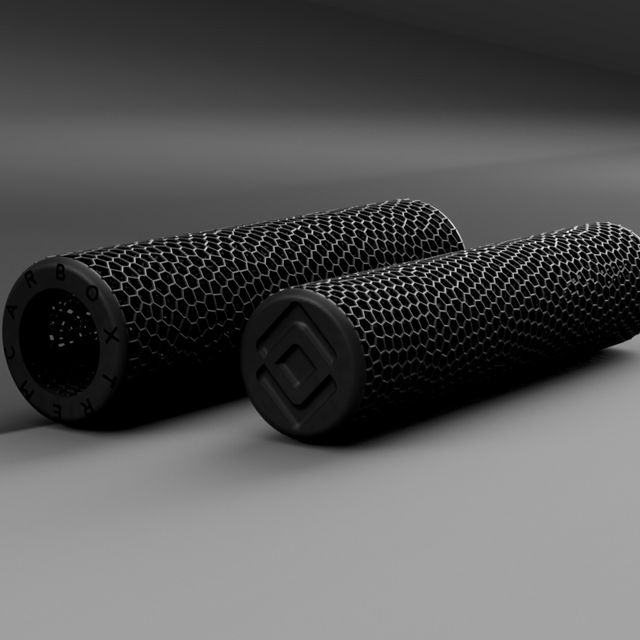
In this article we look at why it happens and what a different approach offers: a grip that isn't a rubber sleeve but a 3D printed lattice with thousands of open cells, like our Race Day Grips.
The problem has a name in engineering: an interposed water film. Just as a slick tyre aquaplanes because it can't clear water from the contact patch, a grip with a continuous surface has nowhere to push out the water trapped between palm and rubber.
With foam it's even worse: it absorbs. Soaked foam behaves like a saturated sponge — it becomes slippery, loses structure and takes hours to dry. And silicone compounds, very pleasant in the dry, are among those that lose the most friction with a water film.
Brands try to mitigate it with textures, diamonds and grooves. It half works: the grooves on a moulded grip are shallow, because a mould can't produce deep, open geometries without the part getting trapped inside the mould itself.
This is where 3D printing changes the rules. Our Race Day Grips aren't made in a mould: they're printed using Carbon DLS (Digital Light Synthesis) technology, layer by layer with light, in an open-cell 3D Voronoi structure — a geometry that's impossible to mould.
In the wet, that structure does three things a continuous surface can't:
The practical result: you grip with less force. And gripping with less force for two, three or six hours is the difference between finishing with fresh forearms or with the classic "I've got no hands left".
Wet weather doesn't come alone. With cold and damp, the hand loses sensitivity and vibration from the terrain punishes twice as hard. The same lattice that drains the water works here as suspension: the EPU cell structure deforms and recovers with every impact, absorbing up to 80% more vibration than a foam or silicone grip.
Less vibration transmitted means less numbness, less tingling and finer control of brakes and shifters — exactly what goes first when your glove is soaked.
Our lattice is put to the test in real racing, in the hands (and on the saddles) of sponsored riders who don't choose their calendar by the weather forecast: mud, water, dust and constant changes of pace. Race Day Grips are used on XC and marathon bikes, and those demands are part of the reason Carbon (Carbon3D) has officially featured them as a success story in the sports sector.
The same recipe applies to the e-bike, the winter marathon or the Sunday ride in the rain: wherever there's water between your glove and your flat handlebar, a continuous surface works against you.
| Feature | Detail |
|---|---|
| Structure | Open-cell 3D Voronoi lattice (a single piece, no mould) |
| Material | Loctite EPU 41 — elastomeric polyurethane, doesn't absorb water |
| Manufacturing | Carbon DLS (Digital Light Synthesis) 3D printing |
| Grip | Open cells that drain water: grip in the dry, in the damp and in the heat |
| Cushioning | +80% vibration absorption vs. foam or silicone grips |
| Weight | Ultralight: 16 g per set |
| Use | XCO, marathon, e-bike and any flat-bar bike, all year round |
| Recognition | Official Carbon3D success story in the sports sector |
| Price | €75 per set |
A reasonable fear: "if it's a lattice, won't it break sooner?". The opposite is true. EPU 41 is a material developed to withstand abrasion wear and continuous deformation cycles; it's the same type of elastomer that big brands use in saddles and high-performance sports equipment. The lattice doesn't pack down like foam, doesn't harden in the sun and doesn't get "polished" with use like rubber: the structure keeps its shape and feel wash after wash — because yes, they wash with soap and water and come up like new.
The thinner the glove, the more the hand "reads" the lattice texture. Thick winter gloves work too: the cell edges anchor the fabric just the same.
The advantage of a grip that grips is that it lets you release tension. Let the structure do the work: relaxed hands, fresh forearms, more control.
After a muddy day, soap and water straight onto the lattice. Being open cells in a material that doesn't absorb, they dry in minutes.
Because their continuous surface traps a film of water between palm and grip. Foam also absorbs water like a sponge. An open-cell 3D lattice drains the water and keeps the contact edges working.
No. Loctite EPU 41 doesn't absorb water and resists abrasion. After a muddy day they wash with soap and water and dry in minutes.
Moulding only allows surface textures. DLS printing produces deep open cells that drain water, anchor the glove and absorb up to 80% more vibration than foam or silicone.
XCO, marathon, e-bike and winter rides: any flat handlebar where grip and vibration matter. They weigh 16 g per set.
If this winter (or this summer of storms) you've felt the handlebar slipping away under your glove, don't change gloves just yet: change what's underneath. Race Day Grips are printed with light, tested in the mud and, now and then, end up on the podium.
Topics