CarboXtrem TT Aerobars
€890,00
CARBOXTREM
Pre-launches, custom-fit tips and offers for your bike. No spam: only what is worth it.
Already have an account? Sign in02/07/2026 · Alfonso Lopez Pe

You finish a long ride shattered and think you lacked endurance. Often that isn't it. It's vibration. Every bump, every stretch of gravel, every cobble and every root sends micro-jolts through the bike into your body, and they do it for hours. You don't notice any of them individually, but they add up: it's the invisible fatigue that turns into numbness, pressure at the contact point, a loaded lower back and that "my legs just weren't there today" feeling.
Of the three contact points with the bike —hands, feet and saddle—, the saddle bears most of your weight for the longest time. That's why it's also where vibration builds up the most. And this is where the technology your saddle is made with makes the difference between arriving in one piece or arriving wrecked.
The classic saddle is basically a rigid shell with a layer of foam or gel on top and a cover. That design has two problems when the terrain gets rough:
What's more, being a standard format, a traditional saddle distributes pressure its own way, not yours. If your sit bones don't line up with the saddle's support area, pressure concentrates where it shouldn't: on soft tissue. Hence the classic numbness on long rides.
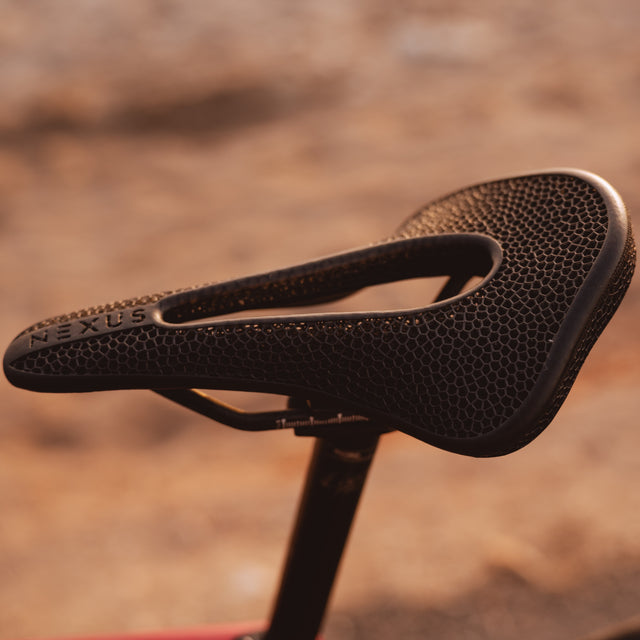
The Carbon 3D NEXUS Saddle has no foam. It's a single-piece lattice structure, 3D printed with Carbon3D's Digital Light Synthesis™ (DLS) technology in Loctite EPU 41 resin. Instead of a mass of foam, you have thousands of small hollow cells working together. And that change of concept is what changes how it feels beneath you at kilometre 90.
The NEXUS lattice uses a Voronoi pattern, the same geometry used by premium brands in the industry. Instead of bouncing the impact back, each cell deforms in a controlled way and absorbs the vibration before it reaches your body. Multiply that by thousands of cells and millions of micro-impacts over a ride: the result is a surface that cushions continuously, not just at single points.
The material matters as much as the geometry. EPU 41 is an elastomeric polyurethane: a material designed to flex, recover its shape and repeat the cycle thousands of times without degrading. It doesn't pack down like foam or harden in the cold like some gels. The comfort you have at kilometre 10 is still there at kilometre 100, and the comfort of the first year is still there the next.
Because the structure is printed cell by cell, the lattice density can vary by zone: firmer where pedalling force is transmitted and where the sit bones rest, more flexible in the relief zones. That's impossible to achieve with a uniform sheet of foam, and it's what allows pressure to be genuinely distributed instead of concentrated at one point.
On smooth tarmac any saddle "feels fine" for the first two hours. Broken ground is another story. On gravel, on long road rides and in bikepacking, vibration is constant and the hours pile up: exactly the scenario where a 3D lattice has the edge over foam. Less vibration transmitted means less numbness, fewer micro-stops to "shift position" and, above all, arriving with energy to spend where it matters —in your legs— rather than wasting it putting up with discomfort.
An extra note for dirty terrain: being an open structure, the lattice breathes and doesn't hold water or sweat the way a foam cover does. Less heat and less moisture at the contact area also means less chafing on long rides.
A saddle that cushions too much for your weight sinks; one that cushions too little batters you. That's why the NEXUS isn't made in a single version: the lattice density is matched to your weight (with ranges such as 55-65 kg, 65-75 kg, 75-85 kg…) and the right width is chosen according to your sit bone support (options from 70 mm to 160 mm). That way the cushioning works at its optimum point for you, not for an average cyclist who doesn't exist.
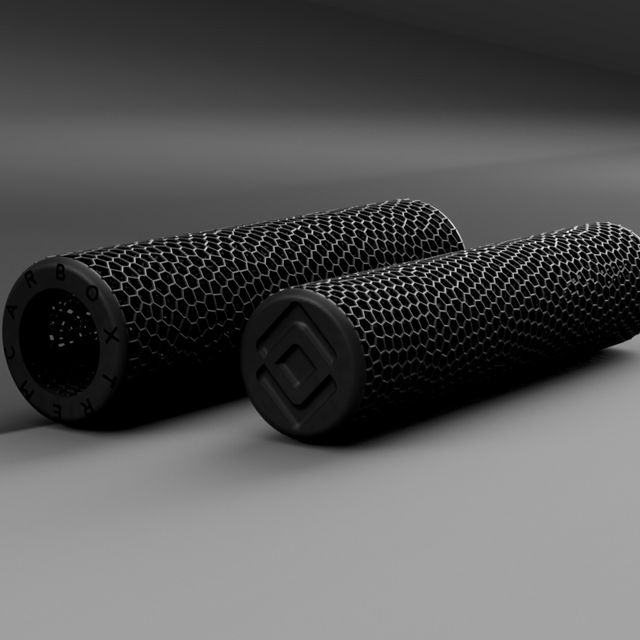
This made-to-measure manufacturing logic is the same one we apply to the other contact points, such as the Race Days grips, also made from a 3D lattice, to tackle vibration in the hands too.
| Feature | Detail |
|---|---|
| Technology | Carbon3D Digital Light Synthesis™ (DLS) 3D printing |
| Material | Loctite EPU 41 resin (elastomeric polyurethane) |
| Structure | Lattice with a Voronoi pattern, single piece |
| Weight | 146 g (among the lightest for its size) |
| Dimensions | Compact 240 × 140 mm format |
| Customisation | Made to measure according to weight and sit bone width |
| Ideal for | Gravel, road, MTB, long rides and bikepacking |
| Price | From €250 |
| NEXUS 3D Carbon Saddle | Traditional saddle | |
|---|---|---|
| Cushioning | A lattice that deforms and absorbs vibration | Foam/gel that rebounds and passes on part of the jolt |
| Comfort durability | EPU 41 elastomer that doesn't pack down over the km | Foam compresses and "bottoms out" over time |
| Pressure distribution | Density tuned by zone and to your width | Standard format, generic distribution |
| Breathability | Open structure that ventilates | Closed cover that traps heat and sweat |
| Weight | 146 g | Usually heavier, in smaller sizes |
Yes. The NEXUS lattice is made up of thousands of cells that deform in a controlled way and absorb vibration, instead of bouncing it back as a homogeneous foam does. And EPU 41 is an elastomer that doesn't pack down over the kilometres, so the comfort lasts over time.
That's where you notice it most. On broken ground and over many hours of riding the vibration is constant, and the 3D structure reduces the micro-impacts that reach your body, reducing numbness and fatigue. It also breathes better because it's an open structure.
It's made to measure by matching the lattice density to your weight (ranges such as 55-65, 65-75 or 75-85 kg) and choosing the right width according to your sit bone support, with options from 70 mm to 160 mm.
It weighs 146 g in a compact 240 × 140 mm format, one of the lightest on the market for its size.
If terrain vibration is taking its toll, the problem may be right underneath you. The Carbon 3D NEXUS Saddle cushions where a traditional saddle passes on every jolt, and it's made to measure for your weight and width.
Topics