CarboXtrem TT Aerobars
€890,00
CARBOXTREM
Pre-launches, custom-fit tips and offers for your bike. No spam: only what is worth it.
Already have an account? Sign in15/06/2026 · Alfonso Lopez Pe

When someone picks up one of our components for the first time, the same question almost always comes: "is this 3D printed?". And the right answer is the most interesting one: it depends on the part. Two very different manufacturing technologies coexist at CarboXtrem, and understanding which one we use in each component —and why— is the best way to understand what you are buying.
There is a widespread idea that "all modern carbon comes out of a printer". It doesn't. 3D printing is an extraordinary tool for certain things and completely unsuitable for others. The key isn't choosing one technology and forcing it into everything, but using the right tool for each job. That is exactly what we do.
So we don't get lost, let's pin down the two protagonists from the start:
One builds structure. The other builds contact and comfort. And they almost never compete: in many of our products they coexist in the same part.
Hand lay-up of carbon fibre is a craft process. A technician places each sheet of carbon fabric orienting the fibres in the exact direction the part will be loaded. It's no minor detail: carbon fibre is extremely strong in the direction of the fibre, so deciding which way the fibres of each ply "face" is, literally, designing how the part behaves under load.
At CarboXtrem we use T1000-grade carbon fibre, one of the highest qualities available for high-performance applications. With it we hand lay the parts that have to withstand the real forces of cycling: braking, steering, the effort of a sprint. The result is a structure that doesn't flex when it shouldn't and still weighs a fraction of what it would in aluminium.
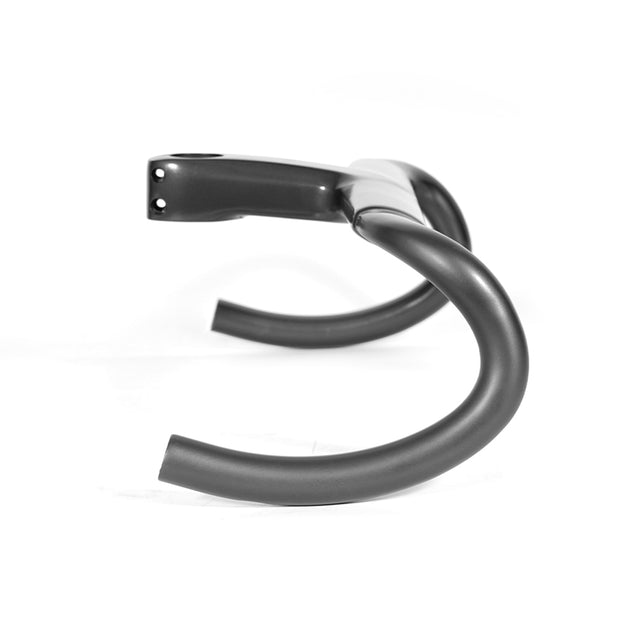
The clearest example is our CarboX17 Handlebar, a one-piece integrated cockpit that joins stem and bar with an aerodynamic profile. And also the body of our CarboXtrem TT and Aero aerobars: the aerobar structure is hand-laid carbon, not a printed part. It's an important nuance, because people often assume the whole aerobar "is printed", and it isn't.
If carbon is king of structure, 3D printing is queen of contact. This is where Carbon DLS (Digital Light Synthesis) technology shines: it lets us make lattice structures —three-dimensional cell structures— that are impossible to make with foam, moulds or machining.
The material of those lattices is EPU elastomeric polyurethane (in its EPU 41 / EPU Pro and EPU 46 variants), an elastomer that absorbs vibration, recovers its shape and doesn't harden in the cold. The great advantage of a printed lattice is that we can tune the density cell by cell: softer where you rest your weight, firmer where you need support. And all of it tailored exactly to the rider.
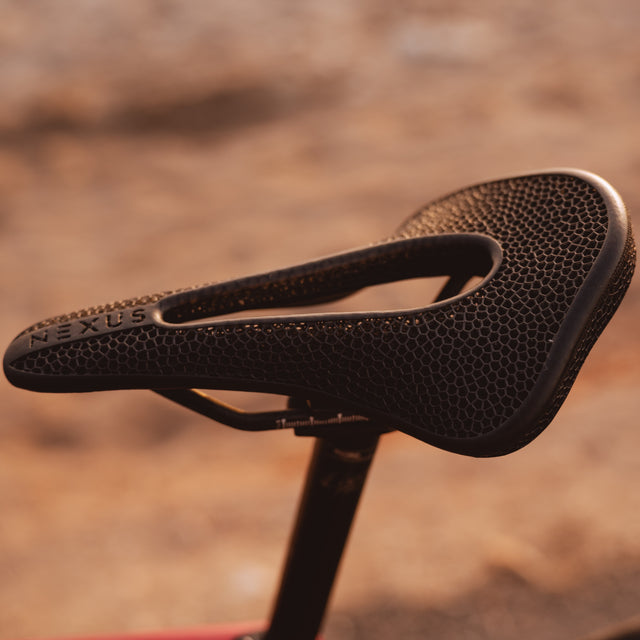
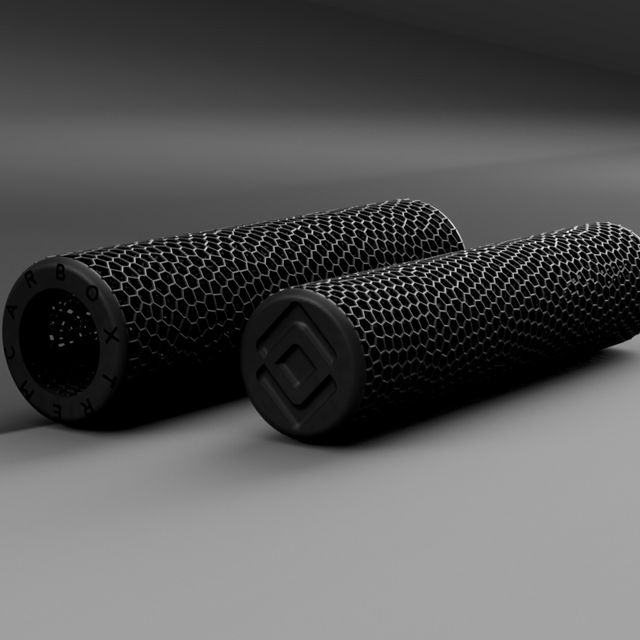
This is where our best-known products come in: the NEXUS 3D Carbon Saddle (a one-piece lattice, among the lightest on the market), the Race Day Grips (3D grips) and the aerobar arm pads. In all of them, what your body touches is printed lattice; what holds the structure, where there is one, is something else.
A CarboXtrem aerobar is the perfect example of how the two technologies work together in a single part:
It isn't "a printed aerobar" or "a carbon aerobar". It is both, each material where it performs best. That is the whole philosophy summed up in one component.
| Criterion | Hand-laid carbon | 3D printing (Carbon DLS) |
|---|---|---|
| Main function | Structure, stiffness, load transfer | Contact, comfort, vibration absorption |
| Material | T1000-grade carbon fibre | EPU elastomer (41 / Pro / 46) and aerospace nylon |
| Strength | Maximum strength with minimum weight | Lattice geometry and density adjustable by zone |
| Customisation | Geometry and fibre orientation | Custom, cell by cell, according to weight and contact point |
| Where we use it | CarboX17 Handlebar, aerobar bodies | NEXUS Saddle, Race Day Grips, aerobar pads |
Beyond technical curiosity, telling the two technologies apart helps you buy better and avoid simplistic messages. When someone sells "carbon" you need to ask how it's made: hand lay-up with oriented fibres is not the same as a part made without control over direction. And when someone sells "3D printing", it's worth knowing with what material and what technology: an EPU lattice made with Carbon DLS has nothing to do with a home filament print.
At CarboXtrem we don't choose a technology because it's trendy. We choose the one that makes each part of the component perform at its best. Carbon where you put down power. Lattice where you rest your body. And every gram exactly where it needs to be.
The structural body of the aerobar is laid up by hand in T1000-grade carbon fibre; it isn't printed. What is 3D printed are the arm pads (EPU lattice) and certain adapters in aerospace-grade nylon.
They don't compete. Hand-laid carbon wins on structure, stiffness and weight; 3D printing with an EPU lattice wins on comfort, zone-by-zone fit and vibration absorption. The optimal approach is to combine them, each in its place.
Both are 3D printed as a one-piece lattice with Carbon DLS technology and EPU material, tuned to your weight and your contact area.
The best way to understand why we use each technology is to try the components that combine them. Start with the cockpit that sums it all up: a hand-laid carbon structure designed for performance.
Discover the CarboX17 Handlebar →
Looking for comfort at your contact points? Take a look at the NEXUS 3D Carbon Saddle and the Race Day Grips.
Fitting triathlon aerobars? You'll want our guide to choosing between an aero vs flat handlebar and getting the size right.
Topics