CarboXtrem TT Aerobars
€890,00
CARBOXTREM
Pre-launches, custom-fit tips and offers for your bike. No spam: only what is worth it.
Already have an account? Sign in19/06/2026 · Alfonso Lopez Pe

Anyone who has ridden enough knows it: the saddle that felt wonderful the first year isn't the same a few months later. It feels harder in some areas, sunken in others, and your posture changes without you having changed it. The same happens with elbow rests and aerobar pads.
The culprit is almost always the padding material. Foam —and gel too— compresses with use, takes on a "memory" and stops recovering its shape. A 3D-printed lattice structure, on the other hand, works differently. In this article we explain why, and what that changes for your comfort over time.
EVA or conventional polyurethane foam cushions by squashing: the air bubbles inside compress and absorb the impact. The problem is that this mechanism wears out. With every ride, with heat and with humidity, those cells break down and stop recovering.
You know the result:
Gel improves initial pressure distribution somewhat, but it carries the same problems: weight, heat and degradation.
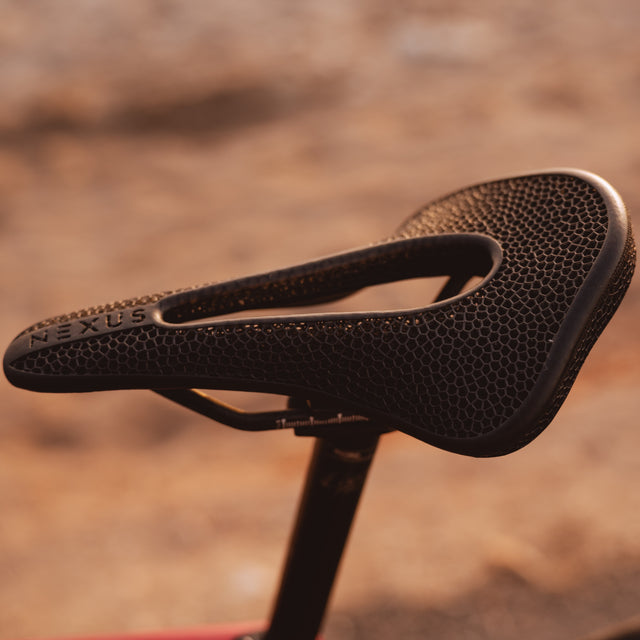
A 3D lattice isn't a solid block: it's a structure of interconnected hollow cells, a lattice designed by computer and 3D printed. Instead of cushioning by squashing trapped air, it cushions by flexing its own geometry: the cells deform under load and spring back when you stop pressing.
It's exactly the same trick nature uses to be light and strong at the same time. The inside of a bone, a honeycomb or a plant stem aren't solid: they're lattices. Material just where it's needed, hollow where it isn't. For decades we didn't know how to make something like that because with a mould it's impossible to create millions of connected hollow cells. 3D printing —specifically Carbon's DLS technology— can: it "draws" the part with light and resin, layer by layer.
If you want to dig into when 3D printing makes sense and when carbon lay-up does, we cover it in our guide to hand-laid carbon vs 3D printing.
The key lies in the material and the geometry. Our lattices are printed in EPU (Carbon's elastomeric polyurethane, in versions such as EPU 41 and EPU 46), an elastic material: it deforms and recovers its shape again and again without "getting tired" like foam. It doesn't depend on air bubbles that break, but on a structure that bounces back.
| Foam / gel | 3D lattice (EPU lattice) | |
|---|---|---|
| How it cushions | By squashing trapped air | By flexing its geometry and recovering |
| Over time | Compresses and takes on memory | Recovers its shape, keeps its support |
| Pressure distribution | Uneven as it degrades | Distributed and tuned by zone |
| Ventilation | Solid block, holds heat | Open cells, breathes |
| Customisation | Single density | Density adjustable by zone and by rider |
Because the lattice is designed cell by cell, we can make it softer where you rest and firmer where you push, within the same part. And we can tune that density to your weight and your contact point. That's something a block of foam, with one density for everyone, can't offer.
It's the same philosophy we use to design pressure distribution in our contact products, as we explain in customisation and biomechanics.
This technology is at the points where your body touches the bike and where foam degradation is most annoying:
| Question | Short answer |
|---|---|
| Why does foam sink? | It cushions by squashing air; those cells break down and don't recover. |
| Why doesn't a 3D lattice? | It's an elastic structure (EPU) that flexes and returns to its shape. |
| Does it spread pressure better? | Yes, and it's also tuned by zone and by rider. |
| Does it breathe better? | Yes, it's open cells versus a solid block. |
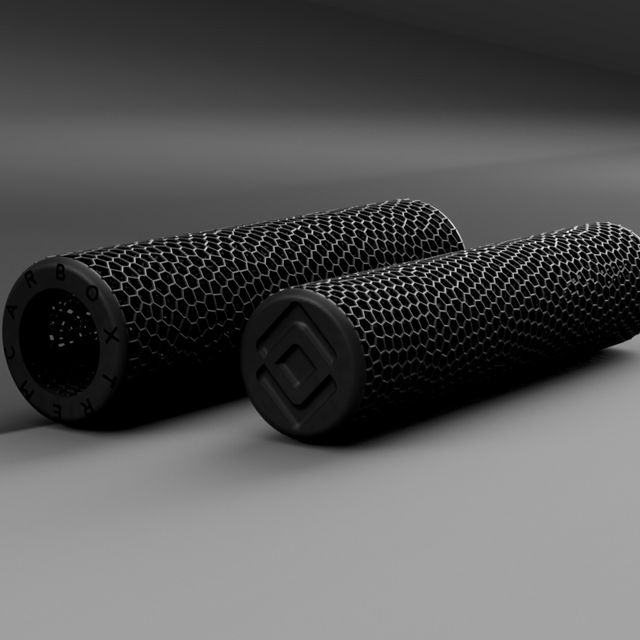
| Where does CarboXtrem use it? | NEXUS saddle, Race Days grips and aerobar pads. |
Because it cushions by compressing the air in its cells. With use, heat and humidity those cells break down and stop recovering their shape.
Not in the same way. An EPU lattice structure is elastic: it deforms and recovers its geometry again and again, keeping its support for much longer.
EPU (Carbon's elastomeric polyurethane, such as EPU 41 and EPU 46), printed with DLS technology and designed by CarboXtrem.
Yes, being open cells it ventilates much better than a solid block.
If you're fed up with your saddle or rests losing their shape after a few months, a 3D-printed lattice is in another league: it keeps its support, spreads pressure and breathes, ride after ride.
Discover the NEXUS 3D Carbon Saddle →
Interested in lattice technology? Also read about customisation and biomechanics and take a look at the Race Days grips.
Topics