CarboXtrem TT Aerobars
€890,00
CARBOXTREM
Pre-launches, custom-fit tips and offers for your bike. No spam: only what is worth it.
Already have an account? Sign in09/07/2026 · Alfonso Lopez Pe

When a rider switches from a conventional saddle to a 3D-printed one, the first question is usually about comfort. The second almost always comes a few weeks later, with the dirty bike in the garage: so how do I clean this? And then comes the real one, the one that worries you when you've just spent money on a component: how long will it last?
They're legitimate questions with few serious answers online. There's a lot of talk about how a 3D lattice is made and very little about living with one for three winters. That's what this article is about: mud, hoses, hours of sun and what really happens to an EPU 41 structure over time.
The quick conclusion, in case you're in a hurry: a 3D lattice saddle is cleaned with soap and water, needs no special products, and its strong point compared with foam is precisely that it has nothing to absorb and nothing to pack down. Now for the details.

A traditional saddle is essentially a sandwich: a rigid base, a foam or gel filling and a cover over the top. That design hides two maintenance problems most riders accept as inevitable.
The first is that the cover is a barrier. When water and sweat get through the seams, there's no way to get them out. The filling acts like a closed sponge: it soaks up water, takes days to dry and, in the meantime, is the perfect place for things to grow that you don't want growing there. The second problem is mechanical: foam works by compressing, and foam that's compressed hundreds of thousands of times ends up losing height and its ability to recover. It doesn't break all at once; one day you simply realise the saddle is no longer the one you bought.
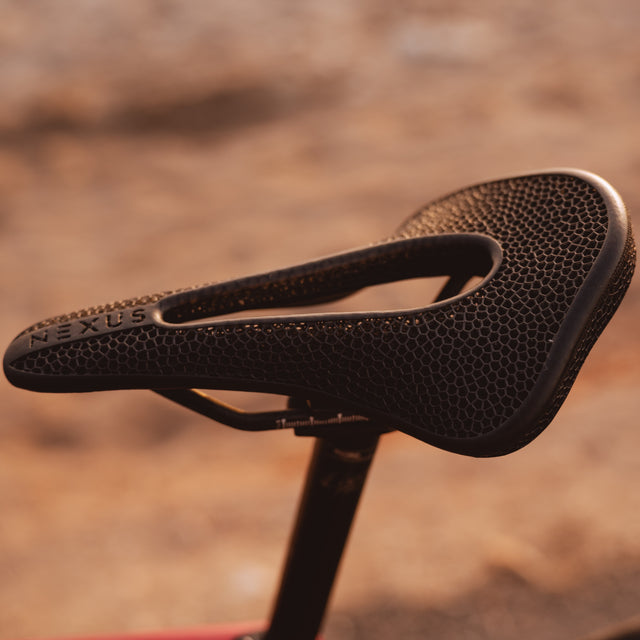
The lattice of the NEXUS 3D Carbon Saddle doesn't work like that. It's an open structure, printed as a single piece with Carbon's DLS technology in EPU 41 elastomeric resin. There's no cover, no filling and no seams. What cushions is the geometry: thousands of Voronoi-design cells that deform and recover, with density tuned zone by zone.
If you're interested in the underlying issue —what exactly happens to foam over time and why a structure doesn't do the same— we cover it in Foam vs 3D Lattice: why your printed saddle doesn't sink over time. Here we focus on the practical side.
The good news is you don't need to buy anything. The whole routine takes five minutes.
Nothing needed. An open-lattice saddle dries on its own, because air circulates through the structure. Sweat doesn't stay inside: it passes through. If you finish the ride with a dusty bike, a damp cloth over the top is enough.
Running water and a soft-bristled brush. The brush is the key: because the surface has relief, dried mud clings in the cells and a cloth just pushes it further in. With the brush it comes out effortlessly. If the mud is really stuck, leave it to soak for ten minutes with the water from the brush and go at it again.
Warm water and a neutral soap —household washing-up liquid will do—. Brush, rinse well and leave to air-dry in the shade. That's all. EPU 41 is a closed elastomer: it doesn't soak up water, so rinsing isn't "wetting the filling", it's simply washing the dirt out.
In the shade and without rushing. No cloth or dryer needed. And here it's worth being explicit about what not to do.
| Avoid | Reason |
|---|---|
| Pressure washer | A direct jet won't damage the lattice, but it can strain the rails and force water and dirt into the seatpost clamp. It's good advice for any saddle. |
| Solvents, acetone, petrol | They're aggressive towards polymers. There's no reason to use them: there's no grease to dissolve. |
| Chain degreasers | Formulated to attack lubricants. If some splashes on, rinse with water and that's it. |
| Steel wool or a hard-bristled brush | They can scratch or cut the fine filaments of the lattice. Soft bristles, always. |
| Drying with a heat gun or in direct sun for hours | Extreme, prolonged heat doesn't suit any elastomer. Shade and patience. |
| Storing the bike wet in a closed cover | Not because of the saddle, but because of everything else. Nothing will happen to the NEXUS. |
Here's the advice that really extends a saddle's life, and it has nothing to do with the lattice.
The point where a saddle almost always fails is the connection to the seatpost. Overtightening the clamp deforms the rails; undertightening lets them move microscopically over every bump, and that movement ends up marking them. Neither shows until it's too late.
The routine, every two or three months:
A saddle that's properly tightened and in place doesn't get damaged. One that's been moving a millimetre over every bump for six months does.
Let's answer this honestly, because it's easy to promise eternity and hard to back it up.
An elastomer isn't indestructible. Given enough years, ultraviolet radiation and load cycles, any polymer changes its properties. What happens is that the failure modes of a lattice are different —and much slower— than those of a foam, and that's the difference you feel on the bike.
Foam degrades through permanent compression: it loses thickness and never comes back. An EPU 41 Voronoi structure works through elastic flexing of its filaments, which is exactly what the material is designed for. There's no filling to compact, because there's no filling. There's no cover to peel, because there's no cover. And there's no trapped water quietly doing its work from the inside, because the structure is open and drains on its own.
In practice: a NEXUS that has been through a winter of cyclocross and a summer of marathons comes out of the season cushioning just like on day one. It's not a sales promise; it's a direct consequence of how it's built. The same reason we fit it to bikes that race and not just to showroom bikes.
What is worth keeping an eye on, and here we're clear: if one day you see a broken filament in the lattice —from a hard knock against a rock, for example, not from use— message us. The structure has plenty of redundancy and one filament doesn't compromise anything, but we'd rather see it.
| Feature | Detail |
|---|---|
| Weight | 146 g |
| Dimensions | 240 × 140 mm |
| Structure | Voronoi-design lattice, variable density by zone |
| Material | Carbon EPU 41 elastomeric resin |
| Technology | Carbon Digital Light Synthesis™ (DLS) |
| Customisation | Chosen according to the rider's weight range |
| Cleaning | Water, neutral soap and a soft-bristled brush |
| Manufacturing | In Europe |
Many "this saddle doesn't suit me" complaints aren't about the saddle: they're about position. Before judging any saddle good or bad, spend an afternoon on height, setback and tilt. A 3D-printed saddle is more forgiving than a foam one because it spreads pressure better, but no structure fixes a badly measured position.
And with the NEXUS there's an added factor: the lattice density is selected according to your weight. A 60 kg rider and an 85 kg rider don't get the same saddle, even though from the outside they look identical. It's the part of the product you can't see in the photo and the one you notice most on the road. We explain it in detail in Customisation and biomechanics: how 3D saddles adapt to you.
With running water, no problem. With a pressure washer, better not: not because of the lattice, which can take it, but because a direct jet can strain the rails and push dirt into the seatpost clamp. It's the same advice we'd give for any saddle.
Warm water and neutral soap. No solvents, acetone or chain degreasers. A soft-bristled brush is the only tool you need to get mud out of the cells.
No. EPU 41 is an elastomer that doesn't absorb liquid, and the structure is open, so water passes through and drains instead of staying inside. That's the main difference compared with a foam filling, which does act like a sponge.
Not the way foam does. Foam loses thickness through permanent compression; the lattice cushions through elastic flexing of its filaments, which is what the material is designed for. After a tough season, the saddle cushions just the same.
Every two or three months, check the seatpost clamp torque with a torque wrench and take a look at the rails where they make contact. That's where the useful life of any saddle is really decided.
Normal use, including the hours of sun on a long summer ride, isn't a problem. What's worth avoiding is leaving the bike stored for months in full direct sun, advice that applies equally to tyres, levers and any polymer on the bike.
A 3D-printed saddle is, paradoxically, one of the easiest components to maintain on your bike. It has no cover to peel, no filling to soak up water and no seams to split. It's cleaned with water, soap and a soft brush. It dries on its own. And the only thing it needs from you is the same as any saddle: that you tighten it to the right torque and check the rails every now and then.
The structure does the rest.
Want to fit one? The NEXUS 3D Carbon Saddle is configured to your weight range, weighs 146 grams and is made in Europe with Carbon's DLS technology. Designed to last seasons, not months.
Topics