CarboXtrem TT Aerobars
€890,00
CARBOXTREM
Pre-launches, custom-fit tips and offers for your bike. No spam: only what is worth it.
Already have an account? Sign in24/06/2026 · Alfonso Lopez Pe

Look at the front end of a high-end road bike and one from ten years ago. The most obvious change is not in the frame: it is in the cockpit. Where there used to be a bundle of cables and hoses coming out of the levers, crossing in front of the stem and bouncing over every bump, today there is a clean, continuous line without a single visible cable. That is internal cable routing, and it has become one of those upgrades that, once you try it, you don't want to give up.
In this article we explain exactly what it is, why it really matters (beyond looks), what its real drawbacks are and how our CarboX17 integrated handlebar solves it.
Internal cable routing means running the gear cables and brake hoses inside the handlebar, stem and frame instead of leaving them outside. From the levers to the groupset and brakes, the route is hidden.
Semi-internal routing is the halfway option: part of the route is hidden and part stays accessible on the outside. You lose a little of the total cleanliness, but it is easier to maintain the bike. It is neither better nor worse: it is a decision based on how you use your bike.
The CarboX17 is designed for both approaches: it is compatible with internal and semi-internal routing, so you choose the level of integration you want without changing handlebar.
When you ride, the area around your hands and handlebar is one of the first surfaces the wind strikes. A loose cable crossing in front of the stem creates turbulence right there, in the worst possible place. Hiding that cabling reduces the exposed frontal area and smooths the airflow around the front end.
Don't expect the savings of a time trial helmet, but at sustained road speeds every watt counts, and cleaning up the cockpit is one of the cheapest ways to win a few back. That is why every high-end, performance-oriented handlebar goes for integration.
Let's be honest: a bike with a clean cockpit simply looks expensive, well kept and fast. The continuous line from handlebar to stem and on to the frame shows intent. It isn't vanity: it is the visible sign of a well-thought-out build, and for many people it is exactly what sets a stock bike apart from a bike that has been built with real care.
A cable that runs inside is protected: it doesn't rub against your knee in turns, doesn't snag when you lean the bike against something, doesn't degrade in the sun or with trail grime, and doesn't get damaged in a silly fall. Less exposure means less wear, and that translates into more consistent shifting and braking over time.
It isn't all upside, and we'd rather you knew. Internal routing requires a bit more method when it comes to maintenance: changing a housing or bleeding a brake is no longer a matter of pulling one out and pushing another in, you have to guide the route inside. On components that aren't designed for it, that can turn into an afternoon of patience.
That is exactly where the key lies: the handlebar must be designed for internal routing from the outset, with defined channels and well-thought-out entry and exit points. When the routing is solved at the factory, threading the cable stops being a lottery. When you improvise it on a part that isn't prepared for it, you suffer. That is the difference between integrating well and forcing integration.
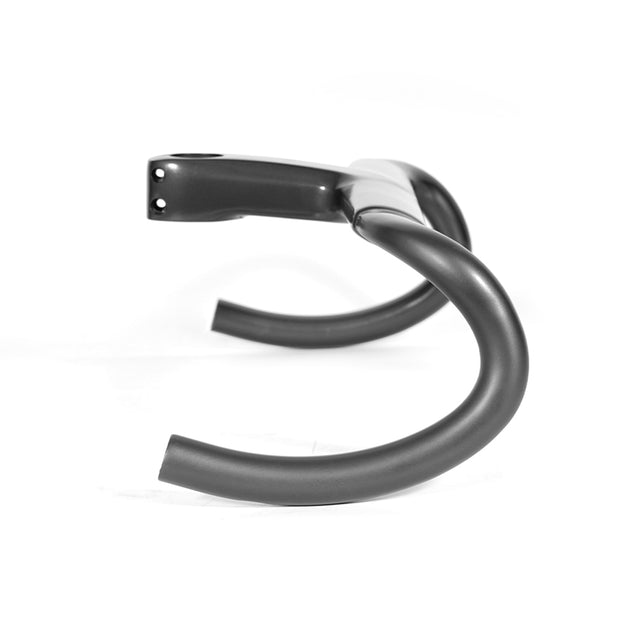
The CarboX17 Handlebar is integrated from birth: handlebar and stem in a single piece, with an optimised aerodynamic profile and internal and semi-internal cable routing planned from the very first line of the design. It is not a handlebar with integration added on: it is integration.
It is made from top-quality T1000-grade carbon fibre, laid up by hand. That construction gives it a robust structure that handles steering and braking forces without flexing, so every input at the handlebar goes cleanly to the wheel: control and precision on every ride. And with everything in one piece with hidden cables, the front end is as clean as it is stiff.
It is also compatible with bike computer and accessory mounts, so you can build a professional, functional cockpit without hanging adapters that break the line or bring cables back into view.
| Feature | CarboX17 Handlebar |
|---|---|
| Construction | Handlebar and stem integrated in a single piece |
| Material | High-end carbon fibre (T1000 grade), laid up by hand |
| Profile | Aerodynamically optimised to reduce wind resistance |
| Cable routing | Compatible with internal and semi-internal |
| Stiffness | Handles steering and braking without flexing |
| Accessories | Bike computer and accessory mounts |
| Use | Performance-oriented road riding and long distances |
| Warranty | Lifetime |
The CarboX17 is for the performance-oriented road cyclist who wants the clean, aerodynamic front end of a high-end bike, with the stiffness to sprint and brake hard without the handlebar complaining, and the comfort of a cockpit designed for long distances. If you care as much about how your bike rides as about how carefully it is built, this is your handlebar.
With internal routing the cables are completely hidden from handlebar to frame; with semi-internal routing part of the route remains accessible on the outside to make maintenance easier. The CarboX17 supports both.
It reduces frontal area and turbulence around the cockpit, which is one of the first areas the air hits. The gain is real at sustained road speeds, although it depends on the build and the position.
It takes a bit more method, but a handlebar designed for it, with defined internal channels like the CarboX17, makes threading the cable much simpler than improvising it on parts that aren't prepared for it.
Yes, it is compatible with bike computer and accessory mounts, for a tidy, professional cockpit.
Internal cable routing is no longer a team-bike luxury but the logical way to build a cockpit: more aerodynamic, cleaner and with the cables better protected. The condition is doing it on a handlebar designed for it. The CarboX17 is: real integration, top-quality hand-laid carbon and compatibility with internal and semi-internal routing, so you can build the front end your bike deserves.
Topics