CarboXtrem TT Aerobars
€890,00
CARBOXTREM
Pre-launches, custom-fit tips and offers for your bike. No spam: only what is worth it.
Already have an account? Sign in23/02/2024 · Alfonso Lopez Pe

It is one of the questions we get most often, and the honest answer is neither yes nor no: it is "depends on which part".
An aero aerobar is not a single object out of a machine. It is an assembly of parts with very different jobs: one has to bear the full weight of your upper body for five hours; another has to grip a handlebar of a specific diameter without moving; and another has to be in contact with your forearm without making it go numb. Asking a single technology to solve all three is asking too much.
So at CarboXtrem we use two, and each one does what it does best. This is what is inside an aerobar, part by part.

Let's start with what matters, because this is where the most confusion lies: the aerobar structure does not come out of a 3D printer. It is laid up by hand in carbon fibre.
It is the part that supports your body. The weight of your whole upper body rests on it while you ride in the aero position, and it is what transmits what you do with your arms to the rest of the bike. It needs a stiffness and fatigue tolerance that today are achieved by laying up fibre: placing the material in the direction the loads will come from, ply by ply, by hand.
High-end aerobars use T1000-grade fibre. And here it is worth clearing up another common confusion: T700, T800 and T1000 are not brands, they are quality grades of the material. It is a scale, not a logo.
Laying it up by hand isn't craft nostalgia: it is what allows each cockpit to be built for a specific body instead of coming out of a one-size mould. We cover it in depth in why CarboXtrem TT aerobars are laid up by hand.
That said, 3D printing plays a big part in the aerobar. Just in the parts where it adds something hand-laid carbon can't: exact, repeatable geometry, fitted to each rider to the millimetre.
Certain parts of the aerobar —the brackets and adapters that act as the interface between the structure and your handlebar— are 3D printed in aerospace-grade nylon.
It makes complete sense. They are parts with complex geometry that must fit a specific handlebar diameter and shape, and they change from bike to bike. Making them by printing lets us fit them to the exact measurements of your setup instead of forcing you to adapt to a standard bracket with spacers and workarounds. It is the difference between a part that fits and one that "almost" fits.
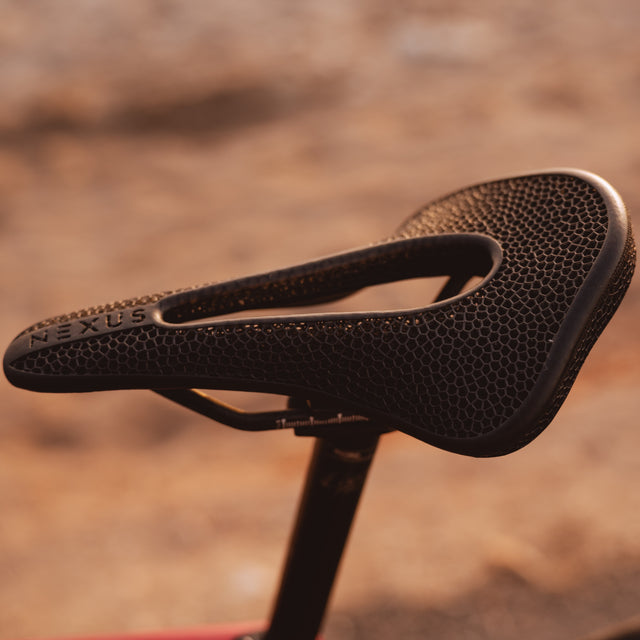
And now we come to the part people recognise at a glance. All our aerobars feature 3D lattice structures: that open-cell structure you see on the arm rests that looks like no foam at all.
We don't print them ourselves. They are made by Carbon —the company, with its DLS technology— to a CarboXtrem design. The material is elastomeric polyurethane: EPU 41 / EPU Pro and EPU 46.
What matters isn't the name of the material, but what the geometry lets you do with it: each lattice is optimised in density and size for the rider. In a foam, the hardness is the same throughout the part. In a lattice, the density is tuned zone by zone: softer where the bone rests, firmer where you need to push. And because it is an open structure, it doesn't behave like a sponge: it breathes.

In short: each technology does what it is good at.
Hand-laid carbon provides structural stiffness and fatigue resistance where the load is serious and sustained. 3D printing provides impossible geometry and millimetre-level customisation where shape is what matters: the fit with your handlebar and the contact with your body.
A fully printed aerobar would have wonderful contact and a structure you wouldn't want underneath you in hour four. A fully laid-up one would have a magnificent structure and generic rests, which is exactly where it is decided whether you finish the ride intact or with numb forearms. The trick is not having to choose.
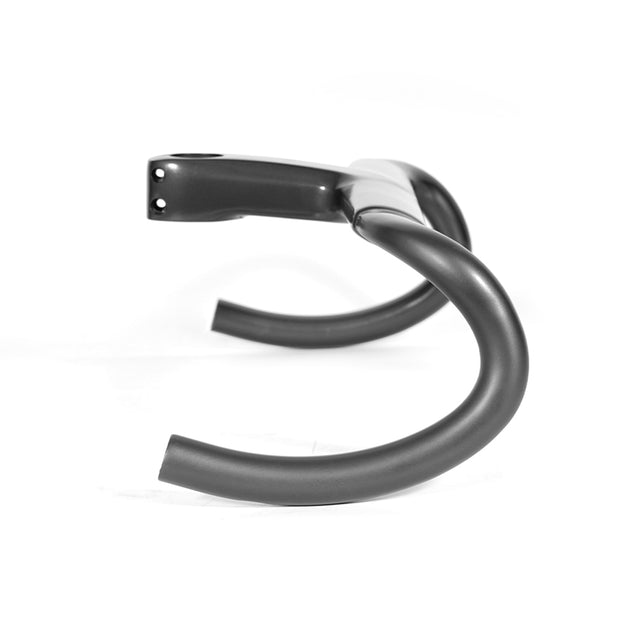
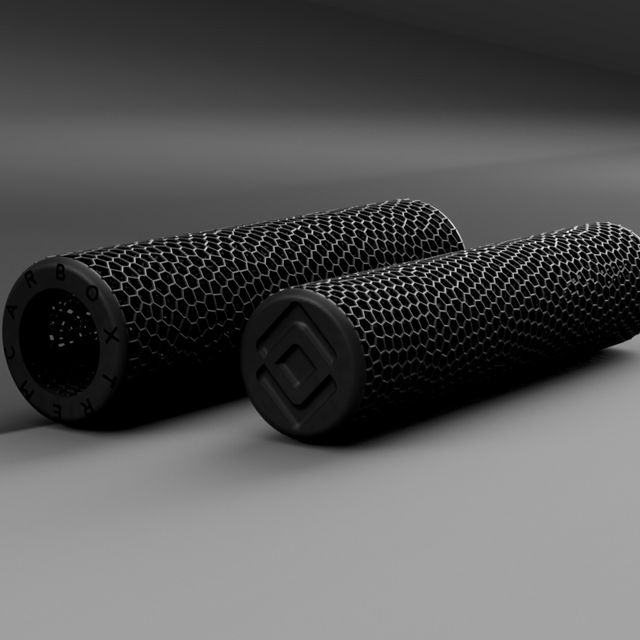
It is the same criterion we apply across our whole range, which is why the NEXUS saddle and the Race Days grips are 3D printed in one piece, while the handlebar and the aerobars are not. We cover it in hand-laid carbon vs 3D printing: when we use each technology.
| Part | How it is made | Material | Why |
|---|---|---|---|
| Aerobar structure | Laid up by hand | Carbon fibre, T1000 grade on high-end models | Stiffness and fatigue resistance under the weight of the upper body |
| Mounting parts and brackets | 3D printing | Aerospace-grade nylon | Exact geometry for your handlebar and your setup |
| Pads / arm rests | 3D printing (Carbon DLS, CarboXtrem design) | EPU 41 / EPU Pro / EPU 46 | Density tuned by zone and by rider, and breathable |
The aerobar structure is not printed: it is laid up by hand in carbon fibre, T1000 grade on high-end models. What is made by 3D printing are certain mounting parts and brackets, in aerospace-grade nylon, and the 3D lattice pads. It is an assembly that combines both technologies, each in the part where it adds most.
Because it is the part that carries the weight of your whole upper body for hours and transmits what you do with your arms to the rest of the bike. Laying up the fibre by hand makes it possible to orient the material in the direction of the loads and build each cockpit to the measurements of a specific body, instead of taking it out of a one-size mould.
No, it isn't a brand. T700, T800 and T1000 are quality grades of carbon fibre: a scale, not a manufacturer. High-end CarboXtrem aerobars use T1000-grade fibre.
They are made by Carbon with its DLS technology, to a CarboXtrem design, in EPU 41 / EPU Pro and EPU 46 elastomeric polyurethane. Each lattice is optimised in density and size for the rider, so the cushioning is tuned zone by zone instead of being uniform like foam.
Millimetre-level customisation. The brackets are fitted to the exact geometry of your handlebar instead of forcing you to compensate with spacers and adapters, and the pads are tuned to your specific contact point. The aerobar adapts to you, not the other way round.
When someone asks whether the aerobars "are 3D printed", they are almost always asking something else: whether they are made for them or whether they are an off-the-shelf product. And that answer is a resounding yes.
3D printing is one of the two tools that make it possible. The other is a pair of hands placing fibre. Neither is superfluous.
👉 Discover the CarboXtrem Custom Aero Aerobars — a custom cockpit for your bike and your body, compatible with all brands.
Do you race time trials or triathlon? Also take a look at the CarboXtrem TT Aerobars, or see how a cockpit is built from scratch in custom aero aerobars: why S/M/L sizes hold you back.
Topics