CarboXtrem TT Aerobars
€890,00
CARBOXTREM
Pre-launches, custom-fit tips and offers for your bike. No spam: only what is worth it.
Already have an account? Sign in21/07/2026 · Alfonso Lopez Pe

You finish your first middle distance or your first time trial, look at the photos and see what everyone sees: you, on your road bike, surrounded by TT machines with deep-section wheels and pointed helmets. And the question comes up: do I need a time trial bike?
The short answer is that it is almost never the first thing you need. The long one —the one that really saves you money— is understanding which part of aerodynamic performance comes from the bike and which part comes from body position, because they are nowhere near evenly split.
This article is an honest comparison of the two options: buying a dedicated TT bike or fitting clip-on aerobars to the road bike you already own. No hype, and no pretending that one of them always wins.
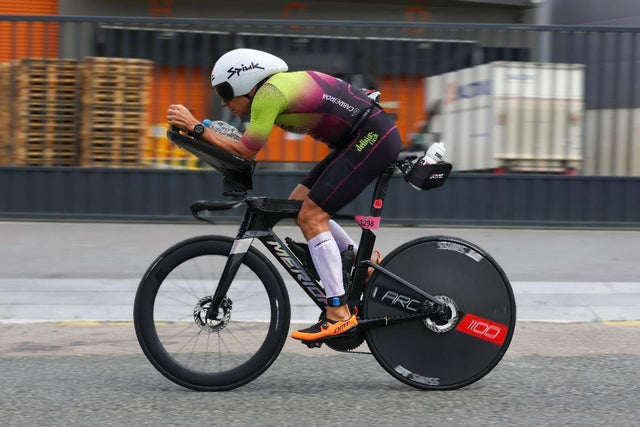
At triathlon or time trial speeds, most of the energy you produce doesn't go into rolling resistance or the drivetrain: it goes into pushing air. And what pushes that air, for the most part, isn't the bike, it's you. The human body —torso, head, arms, thighs— is by far the largest and least aerodynamic object in the whole package.
That leads to the practical consequence that matters: changing the frame changes a small fraction of the total, while changing your position changes the big part. Lowering your torso, bringing your elbows in and putting your forearms together reduces frontal area far more aggressively than any wing-profile tube.
And the frame doesn't give you that position. The aerobars do. A well-fitted set of clip-ons on a road bike puts you, in essence, in the same position as a TT bike: forearms resting, hands together out front, shoulders narrowed.
That is why the logical order of investment, for almost everyone, is: position first, then wheels and rolling kit, and only at the end the frame.

Position being king doesn't mean a TT bike adds nothing. It does, and it is worth knowing exactly what:
And what it costs, which also needs saying: it is a second bike. High entry price, separate maintenance, more awkward to transport, useless for group rides, uncomfortable on long climbs, banned in many draft-legal events and quite limited if your calendar has more sportives than time trials.
The clip-on option turns the bike you already have into two bikes: the usual one for training, group rides and climbing, and an aero setup for the day you race the clock.
Their limits, to be fair: you won't replicate the forward geometry of a TT bike (although moving the saddle slightly forward helps, within what your biomechanics allow), and the setup still has road-bike cables and profiles.
| Aspect | Time trial bike | Road bike + clip-on aerobars |
|---|---|---|
| Source of the aero benefit | Position + geometry + frame | Position (the big part) |
| Investment | Complete bike | A component on what you already have |
| Versatility | Low: TT / tri only | High: on and off |
| Group rides | Not advisable | No problem (aerobars aside) |
| Mountain terrain | A handicap | Same as your usual bike |
| Draft-legal events | Usually not allowed | Depends on the event rules |
| Maintenance | That of a second bike | Practically none |
| Adaptation curve | High: new position and new bike | Medium: new position on a familiar bike |
It is worth it when several of these conditions are met at the same time, not just one:
If two or more of those fail today, the money goes much further on well-fitted aerobars, a good position study and, if there is money left, a set of wheels.
Here is the part almost nobody mentions when comparing frames: the aero position is only useful if you can hold it. A posture that looks perfect in the garage and forces you to sit up after forty minutes isn't an aerodynamic advantage: it's a nice photo.
And what makes it sustainable isn't the frame, it's three very specific things:
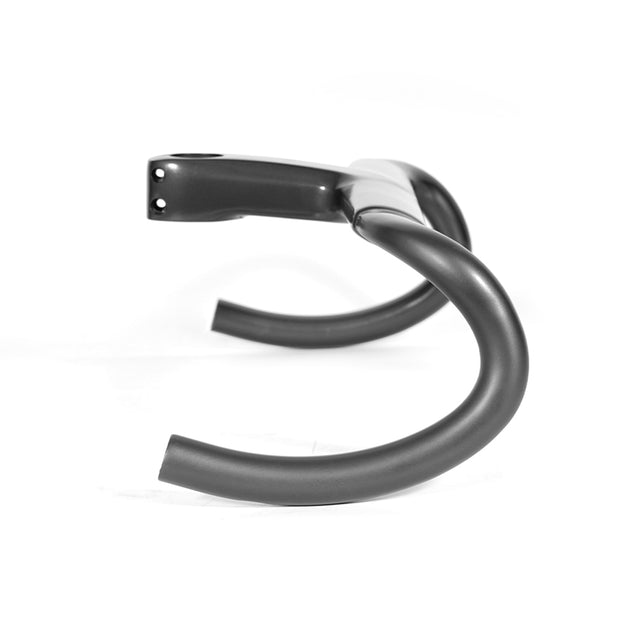
A generic aerobar comes in a single size, or at most in a few sizes. But the arm resting on it is yours. If the extension is too short, you end up hunched with your shoulders compressed; if it is too long, you end up stretching and offloading weight onto your elbows. Our CarboXtrem Custom Aero Aerobars are made to each rider's arm length, with the wrist at a support angle of around 50º. It is exactly the same criterion we explain in custom aero aerobars: why S/M/L sizes hold you back.
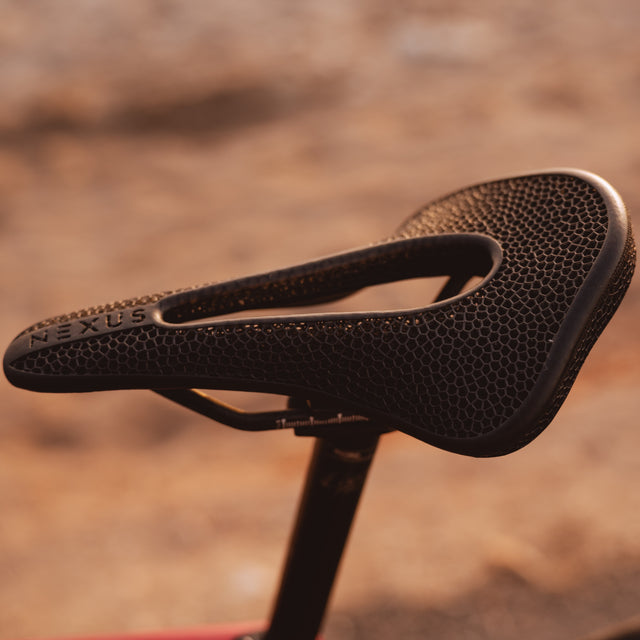
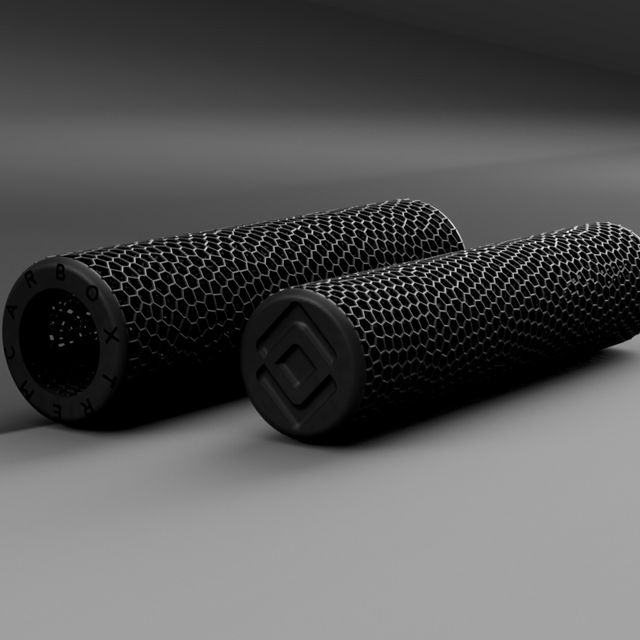
In the aero position your forearm stays pinned to the same spot for hours, without the hand rotation or grip changes a road handlebar gives you. That is why the pad isn't a decorative accessory: it decides whether you finish in one piece. On our aerobars, those rests are 3D lattice structures made by Carbon with DLS technology, in EPU 41 elastomeric polyurethane, with density tuned to the rider. It is an open-cell structure: it gives way in a controlled manner, spreads load and breathes, instead of behaving like a sponge that compresses and holds sweat. If you feel tingling or sore elbows, you'll find the full detail in numb forearms and sore elbows in the aero position.
It pays to be precise, because there is a lot of confusion about 3D printing. On a CarboXtrem aerobar the carbon structure is laid up by hand, with T1000-grade fibre; it doesn't come out of a printer. What is 3D printed are certain mounting parts and brackets in aerospace-grade nylon —which is what allows the assembly to be adapted to your handlebar and your measurements to the millimetre— and the support lattices. Each technology is where it makes sense; we explain it in depth in hand-laid carbon vs 3D printing.

If you are starting out in triathlon or time trials, or if you race occasionally, fit well-adjusted aerobars to your road bike, spend time adapting and put the rest into training that position. You will get most of the aerodynamic benefit for a fraction of the cost, and you will still have a bike that does everything.
If you already race seriously, with a trained position and a calendar that justifies it, the TT bike is the logical next step. And then it will also make sense to perfect the cockpit down to the last detail.
In both cases, one thing doesn't change: you gain speed by holding the position, not by adopting it.
We make every set to the length of your arm, with 3D lattice rests of tuned density, compatible with practically any handlebar on the market. Carbon laid up by hand in Spain and a lifetime warranty.
Only if you race several times a year in non-drafting events, already have a trained aero position and your terrain is flat. If not, well-fitted aerobars on your road bike give you most of the benefit for a fraction of the cost.
On most, yes, including aero handlebars and flat handlebars. It is worth confirming cockpit compatibility before ordering, especially with one-piece integrated handlebars.
It depends on each event's rules: common in time trials and non-drafting triathlon, restricted in draft-legal events and many sportives. Always check the specific regulations.
The carbon structure is laid up by hand with T1000-grade fibre. Certain mounting parts and brackets in aerospace-grade nylon are made by 3D printing, as are the lattices for the rests and grips (Carbon, DLS technology, EPU material).
Allow several weeks of progressive adaptation. Start with short spells in position and gradually lengthen them; your neck and lower back are the areas that feel the change most.
Topics