CarboXtrem TT Aerobars
€890,00
CARBOXTREM
Pre-launches, custom-fit tips and offers for your bike. No spam: only what is worth it.
Already have an account? Sign in17/07/2026 · Alfonso Lopez Pe

With a conventional handlebar, sizing is a conversation that goes on for years. You buy a 100 mm stem, try it, never quite feel comfortable, borrow a 90 and swap it one Saturday morning. The bar stays; the stems rotate through the workshop drawer.
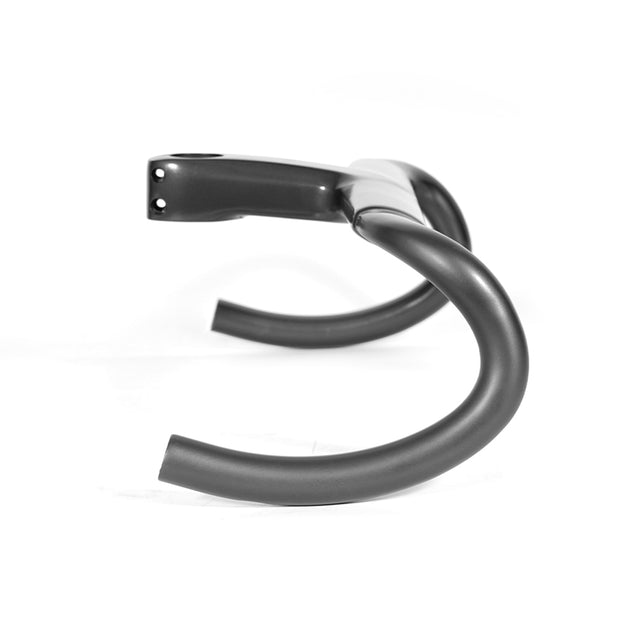
An integrated cockpit works differently. Because the stem and the bar are one continuous piece —which is exactly its advantage: no bolted joint, no hardware in between, no flex point where all the load passes—, the width and stem length are chosen before it is made. There is no bolt to loosen later.
That can feel a little daunting the first time. It shouldn't, because the right size is no mystery: you are already riding it. It is on the bike in your garage, and you can read it with a tape measure in ten minutes. This guide shows you how.

Handlebar width is measured in millimetres and sets the distance between the two grips. It is the measurement most often copied out of habit —"the one the bike came with"— and the one most riders get wrong, almost always by going too wide.
The biomechanical reference is biacromial width: the distance between the two acromions, the bony points you can feel at the top and outside of each shoulder. Find one with your fingers, find the other and measure in a straight line between them. That number, in millimetres, is your starting point.
From there, fine-tune the choice depending on what you are after:
Applied to the three CarboX17 sizes —380, 400 and 420 mm— you get a fairly clear map:
| Width | Rider profile | What it prioritises |
|---|---|---|
| 380 mm | Narrow shoulders, or a rider chasing an aggressive aero position | Minimal frontal area, agility, fast long rides |
| 400 mm | Most road cyclists | Balance between aero, control and breathing |
| 420 mm | Broad shoulders, or riding loaded and on rough surfaces | Stability, leverage, upper-body comfort |
The trend in recent years has pushed towards ever narrower handlebars, and aerodynamic logic backs it up: the rider is by far the largest surface the air meets, so bringing the arms in narrows the frontal area. So far, so good.
The catch is that a bar that is too narrow for your body takes its toll somewhere else. It closes up your rib cage and makes you breathe worse just when you need the most air; it reduces the leverage you need to steer on a technical descent; and it loads your shoulders in a position that is not natural for them. That fatigue does not show up at minute ten, it shows up in hour three, and by then you have lost more than you gained.
The practical rule: go one step below your shoulder width if you are chasing aero and the terrain allows it. Going two steps down, without a bike fit to back it up, is rarely worth it.
If width is about your shoulders, stem length is about your reach: how far your torso stretches to get to the bar. It is the measurement that decides whether you finish the ride with a fresh lower back and neck or tied in knots.
There is no need to guess. If the position on your current bike works for you, that is your length, and all you have to do is read it:
With those two numbers —width and length— your cockpit is defined. And if you have had a bike fit, even better: send us the report and we will work directly from its figures.
This is the moment to fix it, not to replicate the mistake in carbon. Two classic symptoms and what they mean:
And one mistake worth naming: using the stem to correct the wrong frame size. A 120 mm stem does not fix a frame that is too small, it just moves the problem to weight distribution and steering behaviour. The stem fine-tunes your position; it does not rescue a geometry that was never yours.
Length and width are chosen when you order, but height remains adjustable afterwards. The CarboX17 comes with spacers, a stem cap and compatible hardware, so the stack is fine-tuned during assembly just like any standard headset. Raise it, lower it and test: that is not frozen when the piece is made.

It is worth understanding why an integrated cockpit makes you decide in advance: because in exchange it takes things off your plate.
On a conventional cockpit, the joint between stem and bar is a point you have to keep an eye on. It has its torque value, its bolts, its tolerance. It adds grams and adds a joint right where the weight of your upper body passes, through every braking effort and every change of direction. By eliminating it, the CarboX17 comes in at approximately 328 g in size 400, with a clean, continuous transition between stem and bar that the air appreciates. We cover it in depth in why a one-piece cockpit makes you faster.
The other advantage is at assembly: the profile is designed for clean cable routing, compatible with internal and semi-internal routing, depending on how your bike is set up. If you are deciding which cable route suits you, we compare them in internal cable routing through the handlebar.
And there is a deeper idea that goes beyond the handlebar: your contact points with the bike are where performance and comfort are really won, long before more expensive parts further from your body. It is the same reasoning we apply in the 3 contact points on the bike: hands, saddle and feet matter more than almost anything else.
| Feature | Specification |
|---|---|
| Construction | Single piece: integrated stem and handlebar, no bolted joint |
| Material | T1000-grade carbon fibre |
| Widths | 380 / 400 / 420 mm |
| Stem lengths | 80 / 90 / 100 / 110 / 120 mm |
| Weight | Approx. 328 g (size 400) |
| Profile | Optimised aero |
| Cable routing | Compatible with internal and semi-internal |
| Bike computer | Integrated mount (Garmin / Wahoo / Bryton) |
| Includes | Spacers, stem covers and compatible hardware |
| Use | Performance-oriented road riding |
Start from the distance between your shoulders (acromion to acromion) and pick the closest size. If you want a more aerodynamic position, you can go one step (10 to 20 mm) narrower. If you ride on rough surfaces or want more stability and leverage, go one step wider. For most road cyclists, 400 mm is the balance between aerodynamics, control and breathing.
The most reliable way is to measure the one you already have: many stems have the length engraved on the side and, if not, measure with a tape from the centre of the steerer tube to the centre of the handlebar, axis to axis. If your current position works for you, that is your size. The CarboX17 is available from 80 to 120 mm in 10 mm steps.
No. In an integrated cockpit the stem and bar are one continuous piece, so width and length are chosen when you order it. Height, however, can still be adjusted afterwards with the included spacers. That is why it pays to measure the position on your current bike, or start from a bike fit, before placing your order.
A narrower bar reduces the frontal area facing the wind, but there is a practical limit. If it is too narrow for your shoulders, it closes your rib cage so you breathe worse, and it reduces the leverage you need to steer on descents. Going one step below your shoulder width usually pays off; going two, without a bike fit to back it up, rarely does.
Approximately 328 grams in size 400. Integrating stem and bar in a single piece of T1000-grade carbon fibre eliminates the bolted joint between them, and with it the hardware and extra material that joint requires.
In three steps: measure your shoulders for the width, read the stem you already run for the length and leave the height for assembly day, because that remains adjustable. With those two numbers, ordering an integrated cockpit stops being a leap of faith and becomes what it should be: ordering the piece you already knew you needed.
And if you have any doubts about your measurements, message us before you order. We would rather spend ten minutes going over your position with you than make a piece that isn't right for you.
👉 Configure your CarboX17 Handlebar — choose the width (380 / 400 / 420 mm) and stem length (80 to 120 mm), and build a jointless cockpit made to your measurements.
Topics