CarboXtrem TT Aerobars
€890,00
CARBOXTREM
Pre-launches, custom-fit tips and offers for your bike. No spam: only what is worth it.
Already have an account? Sign in23/07/2026 · Alfonso Lopez Pe

It appears on almost every product page: frames, handlebars, seatposts, wheels, aerobars. "Made from carbon fibre." It sounds expensive, light and fast, and yet, on its own, that phrase says absolutely nothing about how the part will behave underneath you.
The reason is simple: between two "carbon" components there can be a bigger real difference than between carbon and a good aluminium. It depends on the fibre grade, on how it has been laid up and on who made it and how. Three variables that rarely appear together in a sales description.
In this article we explain what T700, T800 or T1000 really mean, why the lay-up shapes the result as much as or more than the grade, and which questions to ask to know whether you are paying for engineering or for a sticker.

This is the most widespread misunderstanding. Many people think "T1000" is a manufacturer or a product line from a specific manufacturer. It isn't. T700, T800 and T1000 are carbon fibre grade designations: a nomenclature born in the industry and adopted as a reference standard for classifying filament quality.
In other words: the number tells you about the material, not who makes it. There are several carbon fibre producers in the world and several of them offer fibre equivalent to those grades. At CarboXtrem, for example, we work with Sato-brand fibre in T1000 grade for our high-end structural parts. The brand is one thing; the grade is another.
Simplifying without bending the truth: as the grade goes up, the fibre offers more strength per gram of material. The practical consequence is not just that the part is stronger, but something far more interesting for a cyclist:
To withstand the same load, a higher-grade fibre needs less material. And less material means fewer grams on the bike, without giving anything up.
That is where real weight is saved in a carbon component: not by removing paint or drilling holes, but by being able to build the same part with fewer plies because each ply works better.
Honesty matters here, because this is where many brands cheat. A higher grade is a necessary but not sufficient condition:
That is why the number alone is not enough. It is the first of three pieces of information.
A carbon part is not a solid block: it is a stack of fibre plies impregnated with resin. And carbon fibre is strongly directional: it performs extraordinarily well in the direction its filaments run, and considerably worse across them.
That makes the lay-up the real engineering decision. With exactly the same material, whoever designs the part chooses:
The same fabric, badly oriented, produces a part that flexes exactly where it shouldn't. Well oriented, it produces a part that is stiff where you need to push and slightly compliant where you want it to filter vibration. None of this shows in a catalogue photo, but you feel it over every bump and in every sprint.
Another point where marketing and engineering don't get along. The famous checkered weave that many people associate with "quality carbon" (3K, 12K…) simply describes the type of weave and the number of filaments per tow. It is information about the presentation of the material, not its performance.
In fact, high-performance structural parts rely heavily on unidirectional fibre, with all the filaments aligned: it looks less striking than the classic checkerboard, but it lets you direct strength exactly where it is needed. On many components, the visible weave is a surface finish, not the structure that carries the load.
Fibre alone is not a part: it needs a matrix to hold it in place and transfer loads between filaments. The quality of that resin, the exact fibre-to-resin ratio and the curing process determine whether the laminate delivers what it promised on paper.
Too much resin adds grams without adding strength. Poor compaction leaves voids and bubbles that become weak points. That is why two workshops can start from the same roll of fibre and deliver parts that are nothing alike.
Mass production in moulds has one obvious advantage: cost per unit. A well-amortised mould makes it possible to produce thousands of identical, cheap parts. The problem is exactly that: identical. Changing one measurement means a new mould, so the range is organised into standard sizes and you adapt to what exists.
Hand lay-up reverses that logic. Each part is built ply by ply, which is slower and more expensive, but it allows something a mould cannot offer: adapting the geometry to the specific person who will use it. On a contact component —where your body rests for hours— that difference stops being a technical nuance and becomes the difference between finishing fresh and finishing sore.
If you want to dig into when each technology makes sense, we cover it here: hand-laid carbon vs 3D printing: when we use each one.
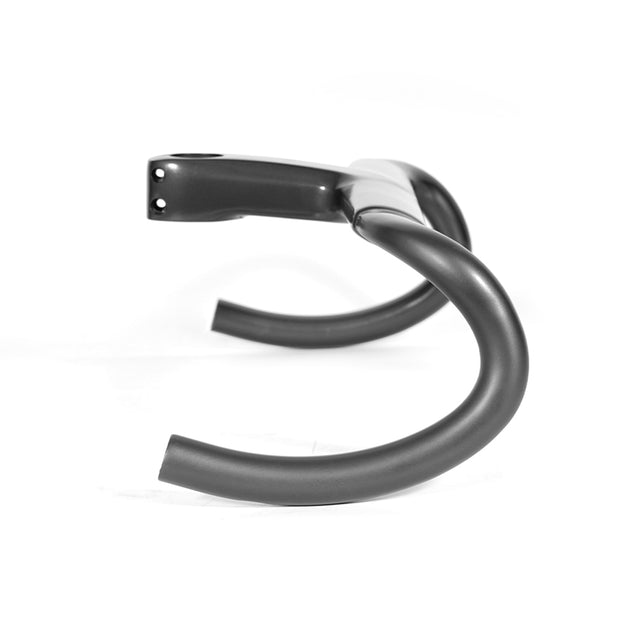
Our structural parts —the structure of our aero aerobars and the CarboX17 integrated handlebar— are made from T1000-grade Sato carbon fibre, and they are laid up by hand, ply by ply.
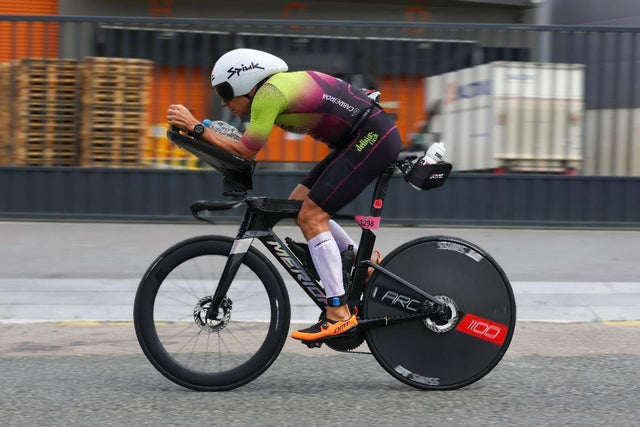
In the case of the aerobars, that handcrafted lay-up is what makes real customisation possible: each unit is built to the rider's arm length, placing the wrist at a 50º angle, with adjustable tilt from 0 to 35º and stainless steel hardware. There are no S/M/L sizes forcing you to pick the lesser evil; we discuss it in detail in custom aero aerobars: why standard sizes hold you back.
| Concept | What it is | What it means for you |
|---|---|---|
| Fibre grade (T700 / T800 / T1000) | Filament quality classification | Higher grade, more strength per gram: less material for the same job |
| Fibre brand | Material manufacturer (in our case, Sato) | Independent of the grade; one does not replace the other |
| Lay-up | Number and orientation of the plies | Decides where the part is stiff and where it filters vibration |
| Unidirectional vs 3K/12K weave | Material format | The visible checkerboard is usually finish, not structure |
| Resin and curing | Matrix and process | Determines whether the laminate performs as promised on paper |
| Mass-production mould vs by hand | Manufacturing method | Fixed sizes versus geometry adapted to your body |
| Carbon at CarboXtrem | Sato T1000 grade, laid up by hand | Custom structural parts, with a lifetime warranty |
A short, effective procedure. For any carbon component, ask these four questions:
If you get all four answers, the price starts to make sense. If you get none, you are probably paying for the glossy finish.
An important clarification, because two very different materials appear side by side in our own photos and it is worth not mixing them up.
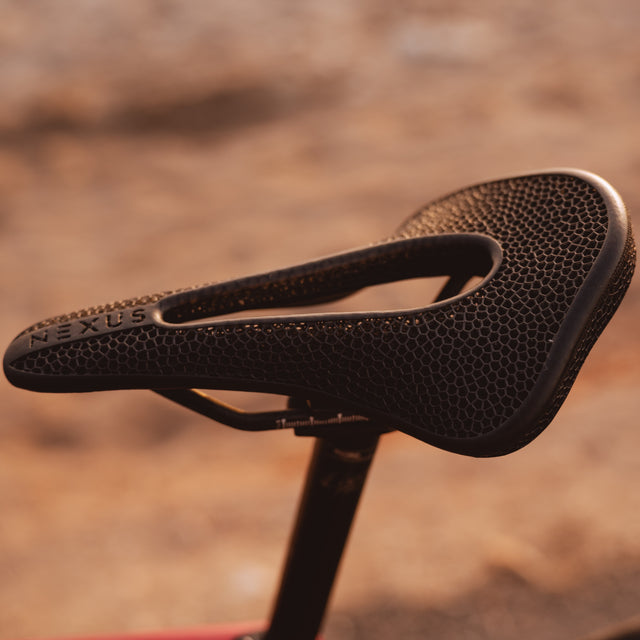
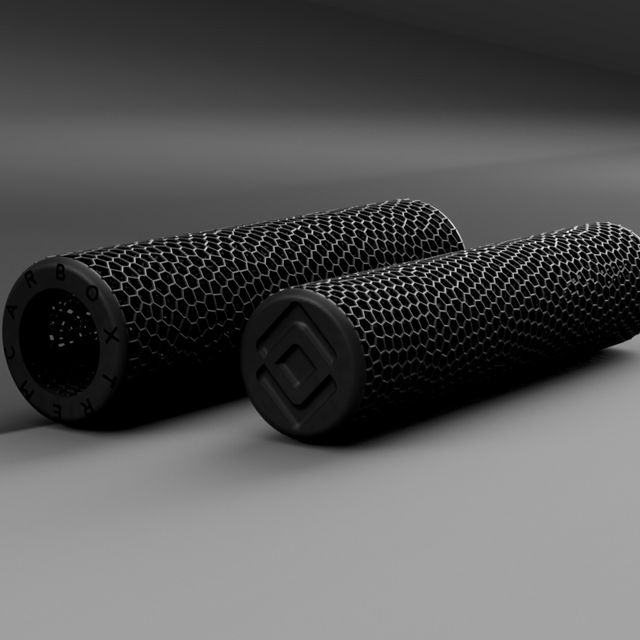
The structure of the aerobar is hand-laid carbon. But the arm pads and grips you see mounted on it are not carbon: they are a 3D-printed EPU 41 lattice, an elastomeric polyurethane from Carbon, with open cells and density tuned by zone. In addition, certain mounting parts are printed in aerospace-grade nylon.
Each material does a job the other could not do well: carbon provides structural stiffness and lightness; the printed lattice provides cushioning, breathability and adaptation to the body. Confusing them —or claiming that "the aerobars are 3D printed"— would be inaccurate. You can see how that lattice behaves in foam vs 3D lattice.
No. They are fibre grade designations: they classify filament quality. The manufacturer's brand is a separate piece of information. At CarboXtrem we use Sato-brand fibre in T1000 grade.
As the grade goes up, the fibre offers more strength per gram of material. In practice, that makes it possible to build the same part with less material and cut weight without losing performance.
Not necessarily. The grade is one variable out of three. A badly designed or badly laid-up part in T1000 can perform worse than a well-executed one in T700, because ply orientation and the manufacturing process matter as much as the starting material.
No. A 3K or 12K weave describes the format of the material, not its performance. Demanding structural parts often use unidirectional fibre, which looks less striking but is more effective.
No. The structure is hand-laid carbon fibre. What is 3D printed are the EPU 41 lattice pads and grips from Carbon and certain mounting parts in aerospace-grade nylon.
Because each part is built ply by ply instead of coming out of a mass-production mould. It is slower, but it makes it possible to adapt the geometry to each rider's arm length and biomechanics.
Carbon is not a category: it is a huge range of materials and processes that share a name. A serious component should be able to answer what fibre grade it uses, how it is laid up and who makes it. When those three answers exist, the price stops being a mystery and becomes a consequence.
At CarboXtrem we work with Sato T1000-grade fibre, laid up by hand, and we build every aerobar to the arm measurements of the person who will use it. It is not the cheapest way to manufacture; it is the one that makes the part fit you, not the other way round.
Want aerobars built to your measurements, with a lifetime warranty? Discover the CarboXtrem Custom Aero Aerobars and tell us how you ride.
Topics