CarboXtrem TT Aerobars
€890,00
CARBOXTREM
Pre-launches, custom-fit tips and offers for your bike. No spam: only what is worth it.
Already have an account? Sign in30/07/2026 · Alfonso Lopez Pe

Almost everything fitted to your bike existed long before you bought it. It was designed for a statistical cyclist, made by the thousand in a mould and waited on a shelf for someone with measurements similar to yours to come to the till. It works, of course. But it works on average.
There is another way to manufacture that reverses the order: first your order arrives, with your data, and then the part is made. No stock, no sizes, no averages. It's known as on-demand manufacturing, and 3D printing has made it viable for components in direct contact with your body: the saddle, the grips and the pads where you rest your forearms.
In this guide we explain what really changes between the two models, what the process looks like from the moment you order until the part reaches your bike, and which components you can order made this way today.
Mass production follows a relentless logic: a mould is very expensive to develop, so it only pays off if it is amortised by making thousands of identical units. That's where sizes come from — S, M, L, three saddle widths, a single rubber hardness — because every new variant requires another mould and another batch.
The result is that a mass-produced product is optimised for the middle of the statistical bell curve. If your weight, your pelvis or your hands are close to that average, you'll have a good experience. The further away you are, the more you notice the part isn't designed for you: padding that sinks because you weigh more than the average user, or barely gives because you weigh less.
On-demand manufacturing removes the mould constraint. A 3D printer doesn't need different tooling for each variant: making two different parts costs the same as making two identical ones. That turns every order into a unique specification — and makes a warehouse unnecessary, because there's no need to guess months in advance which combination of measurements will sell.
When you buy a 3D-printed custom component you don't choose a size: you enter data about your body. For the saddle, for example, there are two — your average weight and your sit bone distance, the two bones your pelvis rests on. If you don't know the second one, you can measure it at home with a piece of cardboard; we explain it step by step in how to measure your sit bones. For custom aerobars, the data are your arm measurements and your position.
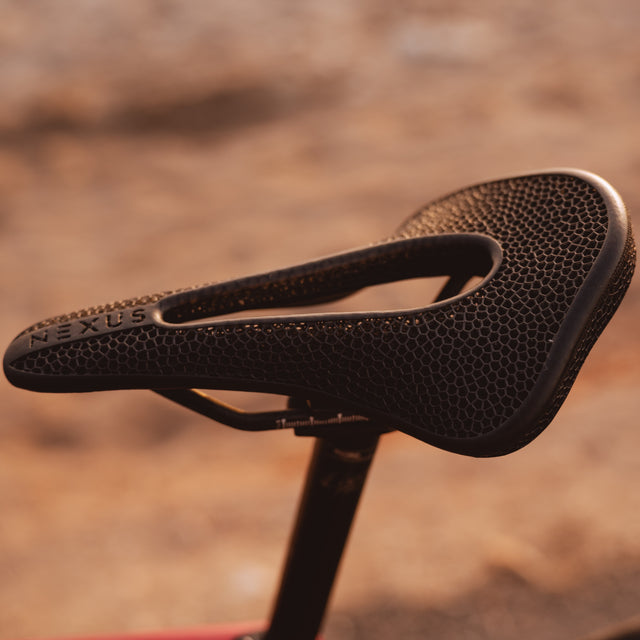
With your data, the part's lattice is adjusted zone by zone. A lattice isn't a block of material: it's a network of thousands of hollow cells, and the size and thickness of each cell determine how much that zone gives under load. The sit bones call for firmness; the transition zones, flexibility; the whole surface, open pores so air can circulate. Your weight decides the overall stiffness: the same part that would over-support a 55 kg rider would give too much under a 100 kg one.
The lattices are made with Digital Light Synthesis (DLS), the technology from the company Carbon. The part emerges from a tank of liquid resin that is solidified continuously by projected light, without the weak layer lines of conventional printing. The material is Carbon's EPU, an elastomeric polyurethane: it behaves like a technical rubber that recovers its shape after every compression and withstands water, sweat and UV rays.

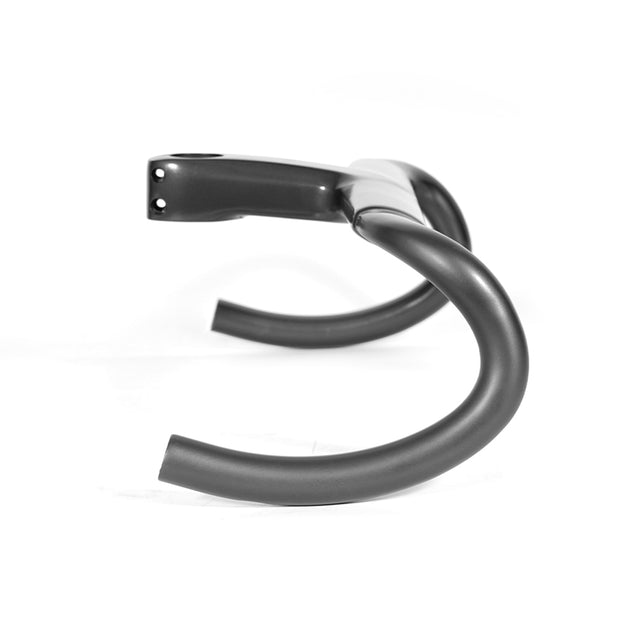
After printing, the part is cleaned of excess resin, cured and joined to its support: on the saddle, a laminated carbon fibre base; on the grips, directly onto your MTB handlebar. An honest clarification is due here: not everything is printed. Load-bearing structures — an aerobar body, a handlebar — are made from hand-laid carbon fibre, piece by piece; 3D printing is reserved for contact surfaces and certain mounting parts in aerospace-grade nylon. Each technology where it performs best: we cover it in hand-laid carbon vs 3D printing.
The most complete case of customisation: the lattice is made according to your weight and sit bone distance, so the support area falls where your pelvis rests, with the firmness that matches your mass. And if you're unsure of your measurement, the order itself includes the option "I don't know — help me choose".
| Feature | Detail |
|---|---|
| Dimensions | 240 × 140 mm |
| Weight | 146 g |
| Core | 3D lattice in EPU 41 resin (Carbon DLS technology) |
| Base | Laminated carbon fibre |
| Customisation | Rider's average weight (55 to 120 kg) and sit bone distance (70 to 160 mm) |
| Resistance | Water, sweat, UV rays and prolonged wear |
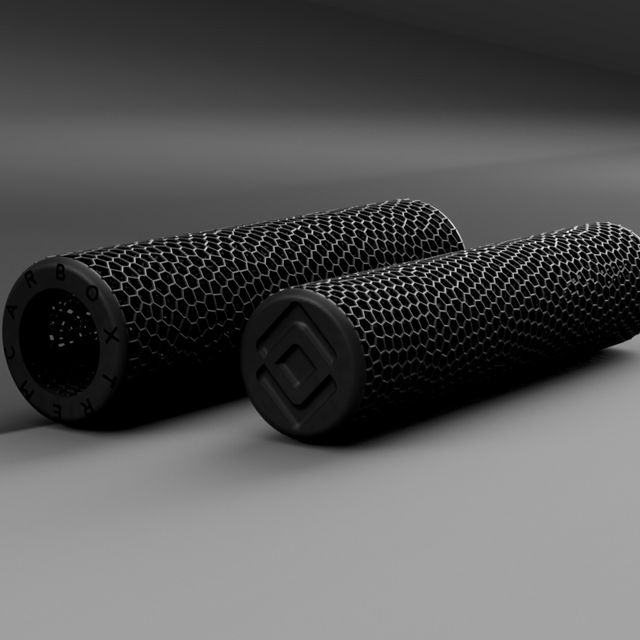
A hollow Voronoi lattice in EPU that cushions without making the grip fatter: 130 mm long with a 22.2 mm inner diameter, the standard for flat MTB handlebars. Being an open-cell structure, the grip doesn't depend on a sticky rubber that degrades: the texture of the lattice itself holds your hand, in the dry and with sweat.
On CarboXtrem aerobars, every pad where your forearm rests is a printed lattice with density and size tuned to the rider. The aerobar structure, on the other hand, is Sato T1000-grade carbon fibre laid up by hand to the length of your arm — the two technologies combined in a single product.

For an informed decision, the other side needs telling too:
| Mass production | On-demand manufacturing | |
|---|---|---|
| When it's made | Months before the sale, in batches | When your order arrives |
| Who it's for | Statistical user (sizes) | The data of the person who ordered it |
| Possible variants | Whatever the mould allows | One per order, at no extra cost |
| Stock | Full warehouses and sold-out sizes | None: no overproduction |
| Availability | Immediate | Requires manufacturing after the order |
| Fit to the body | Approximate, by size | Density and support calculated for you |
That the part doesn't exist until your order arrives. It's made at that moment, with your data, instead of being produced by the thousand months earlier and waiting in a warehouse for someone your size.
Two things: your average weight and your sit bone distance. If you don't know the second one, you can measure it at home with corrugated cardboard — or choose the option "I don't know — help me choose" and we'll guide you.
A bit longer, yes: there's no shelf to take it from. That's the trade-off for a part calculated for your body.
Digital Light Synthesis, from the company Carbon: the part is solidified continuously in a tank of resin by light, without weak layer lines. The lattice material is EPU, an elastomeric polyurethane from Carbon.
No. Contact surfaces and certain mounting parts are printed; load-bearing structures are laid up by hand in carbon fibre.
EPU doesn't pack down or absorb water like foam. With basic cleaning, its useful life clearly exceeds that of conventional padding: you'll find the complete guide in how to clean and care for a 3D-printed saddle.
For decades, buying a component has meant choosing the least bad size from a catalogue made for the average. On-demand manufacturing changes the question: it's no longer "which one fits me best?", but "what data about me does the part need?". It's slower than selling stock, and it doesn't apply to the whole bike — but at the points where your body rests for hours, the difference between a size and a part made for you shows on every ride.
Want to see it on your bike? Start with the two components where you'll notice it most: the NEXUS 3D Carbon Saddle, made to your weight and sit bone distance, and the Race Days Grips, the Voronoi lattice that cushions without fattening the grip.
Topics