CarboXtrem TT Aerobars
€890,00
CARBOXTREM
Pre-launches, custom-fit tips and offers for your bike. No spam: only what is worth it.
Already have an account? Sign in19/07/2026 · Alfonso Lopez Pe

There's an almost automatic reaction among cyclists: when the saddle starts to hurt, they look for a softer one. More gel, more thickness, more padding. It's logical —if it hurts, make it give more— and that's exactly why so many shops still sell saddles that sink a finger's depth when you press them with your thumb.
The problem is that gesture, the thumb test in the shop, measures something that has almost nothing to do with what you'll feel three hours into a ride. A saddle can feel like a sofa on the counter and be torture at kilometre 80. And the other way round: saddles that feel firm to the touch turn out to be the ones that bother you least when it really matters.
The reason isn't mysterious, nor is it a question of "getting used to it". It's physics, and it's easy to understand.
What hurts on a saddle isn't weight. It's pressure, which is weight spread over the area it rests on.
Of those two numbers, you can't change one: your weight, plus the load the terrain feeds back to you bump after bump. The other one you can. The real contact area —how many square centimetres are actually bearing load— is the only variable a saddle can act on.
Put another way: a comfortable saddle isn't the one that sinks the most, it's the one that lets you rest on more area at once. Everything else follows from that.
Here's the counter-intuitive part. Very soft padding —low-density foam, generous gel— doesn't spread the load: it collapses.
When you sit down, your sit bones (the two bones the pelvis rests on) are rigid, relatively small points pushing downwards. If the material beneath them gives way without resistance, those two points go straight through it to the bottom. The padding around them never gets to work: it isn't compressed, it's simply been bypassed.
This is the hammock effect. The material sinks into two wells, you end up resting on the bottom of those wells, and the rest of the saddle —all that area you theoretically paid for— isn't supporting anything. You've reduced the support area instead of increasing it.
And there's a second effect, less obvious and more annoying: as the sit bone area sinks, the displaced material rises at the sides and at the front. That's where the numbness and soft-tissue pressure appear that no cyclist wants to describe out loud. It isn't that the saddle is "too hard". It's that the padding has moved exactly where it shouldn't.

No, and it's worth saying clearly because the pendulum tends to swing to the other extreme.
A completely rigid saddle spreads the load better than a soft, deformed one —which is why many road cyclists end up on seemingly spartan models and feel better—, but it pays a price: it absorbs nothing. Every bump, every cobble and every root reaches the pelvis in full. On a short ride it doesn't take its toll. On a long sportive, on gravel or on a bikepacking day, that build-up of micro-impacts is pure fatigue, the same kind we've already explained when talking about how terrain vibration drains you on long rides.
So the "soft or hard" question is badly framed from the start. They're two ways of failing in opposite directions: one spreads the load badly, the other doesn't cushion. What's needed is a material that does both at once, and a homogeneous foam can't do that, whatever its hardness. A foam has only one number to adjust; turn it up and you gain distribution and lose absorption, turn it down and the reverse happens.
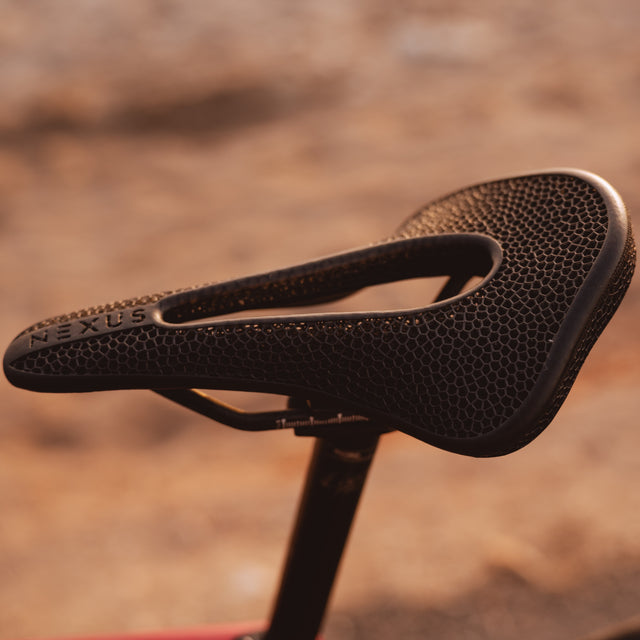
The alternative is to change the category of material. Instead of a solid block with a single hardness, a lattice: a three-dimensional structure made up of thousands of interconnected hollow cells, manufactured by 3D printing.
What changes isn't the feel to the touch but how it behaves under load. A hollow cell doesn't get crushed: it deforms. Its walls flex in a way the designer can calculate in advance, and when the load disappears the cell springs back into place. That provides something foam doesn't: a progressive, predictable response that gives enough to cushion but resists enough not to collapse into two wells.
And here's the important part: the density of those cells doesn't have to be the same across the whole saddle.
In a 3D lattice saddle, the geometry is adjusted by region. Firmer where the sit bones rest, so it doesn't sink and the surface stays wide. More flexible around the edges and in the central area, to follow the pedalling movement and relieve the part where you don't want pressure.
The result is the exact opposite of the hammock effect: instead of shrinking to two points, the support area grows as the structure adapts. And on the Carbon 3D NEXUS saddle that tuning is based on each rider's weight and position, not on a single mould for everyone —a design freedom that only exists when the part is printed rather than moulded.
An open-cell structure is, by definition, full of connected voids. Air circulates and sweat doesn't get trapped in a closed block, which you notice in summer and on long climbs. It's a side effect of the design, not a marketing extra: if the material is hollow, it breathes.
If you're interested in a material-by-material comparison, we cover it in detail in traditional foam vs 3D lattice.
| Feature | Detail |
|---|---|
| Dimensions | 240 × 140 mm |
| Weight | 146 g |
| Pad thickness | 2 cm of cushioning lattice |
| Core material | EPU 41 resin (Carbon's elastomeric polyurethane) |
| Base | Laminated carbon fibre |
| Manufacturing technology | Carbon DLS 3D printing |
| Structure | Lattice with variable density by zone |
| Resistance | Water, sweat, UV rays and prolonged wear |
| Disciplines | MTB (XC, XCM, Enduro), road, gravel, bikepacking, triathlon |
The figure that sums up the approach is the combination of the first two rows: 2 cm of real cushioning for less than 150 grams. With foam and a conventional base, that thickness costs you weight. With a hollow structure, it doesn't.
Three practical criteria, in order of importance:
1. Start with width, not hardness. If the saddle isn't the right width for your sit bone spacing, no material in the world will fix it: you'll be resting off the bones. It's the measurement to take first, and we explain how to do it at home in this guide to measuring your sit bones.
2. Don't trust the thumb test. Pressing with a finger measures the point resistance of the surface layer. You don't sit on a thumb for four hours. What matters is how the whole structure behaves under your weight and in motion, and you can't judge that at the counter.
3. Think about hour three, not minute one. Almost all saddles are comfortable for the first twenty minutes. The differences appear when you've been riding a while, when you've sweated and when the terrain has been hammering you for a good long time. That's the scenario to keep in mind when deciding.
The question starts from a false premise. Comfort doesn't depend on hardness but on how pressure is distributed. A very soft saddle sinks and concentrates the load on fewer points, and a completely rigid one spreads the load well but doesn't absorb vibration. What works is a structure that gives in a controlled way and keeps the support area wide.
When you press it with a finger it feels firm and springy, with immediate recovery. Under the rider's full weight it behaves differently from what that first touch suggests: it gives progressively and adapts. That's why the thumb test is no use for judging it.
146 grams, with a 2 cm cushioning pad and a laminated carbon fibre base.
The EPU 41 structure recovers its shape after every compression and is made to withstand water, sweat, UV rays and prolonged wear. There's no foam to absorb moisture or lose height through accumulated compression. We detail the basic care in our cleaning and maintenance guide.
It's suitable for both. The combination of pressure distribution and vibration absorption is exactly what you appreciate on long days and rough terrain. It's designed for MTB (XC, XCM and Enduro), road, gravel, bikepacking and triathlon.
Yes. The lattice density is optimised according to each rider's weight and support area, something 3D printing makes possible unit by unit without needing a new mould.
Softer isn't more comfortable. It is, almost always, the quickest way to end up resting on less area than you started with. What really gets rid of discomfort is better distribution: supporting where support is needed, giving where it should give and letting air through along the way.
The Carbon 3D NEXUS Saddle is built on that idea: 240 × 140 mm, 146 grams, 2 cm of EPU 41 lattice 3D printed with Carbon DLS technology on a carbon fibre base, with density tuned zone by zone and adapted to each rider.
Stop looking for the saddle that sinks the most. Look for the one that spreads the load best.
Topics