CarboXtrem TT Aerobars
€890,00
CARBOXTREM
Pre-launches, custom-fit tips and offers for your bike. No spam: only what is worth it.
Already have an account? Sign in14/09/2026 · Alfonso Lopez Pe

Anyone who has had a real bonk remembers it with uncomfortable clarity. There was no gradual decline, as when tiredness builds up over the afternoon. You were fine, perhaps even feeling strong, and within minutes everything collapsed: the power vanished, the flat started to feel uphill and your head filled with a thick fog with room for just one thought: getting home.
In Spanish cycling it's called a "pájara"; in English, bonk. And although it feels like physical collapse, what's behind it is much more specific and, above all, much more avoidable: you've run out of available fuel. Not strength, not fitness. Fuel.
In this article we look at what happens inside the body, why it hits all at once, why hunger is a poor warning and how to organise your food on a long ride so it doesn't happen again. And at the end, what to do if it catches you anyway.
To pedal, muscles mainly burn two things: fat and carbohydrates. Fat is a huge reserve even in the leanest person, but it's converted into energy slowly. Carbohydrates are used much faster, which is why they take centre stage as soon as the pace rises. The problem is that we store very few carbs.
The body stores carbohydrates as glycogen, in the muscles and the liver. At a demanding pace, that reserve lasts roughly a couple of hours: considerably less if you're going hard, a bit more if you're riding easy, and it depends a lot on what you ate the day before and that same morning. If you don't top up during the ride, the tank empties. No amount of training makes it infinite.
Muscle glycogen is used up in the muscle itself. Liver glycogen has another job: gradually releasing glucose into the blood to keep its level stable. When that reserve also runs out and nothing new comes in, blood glucose starts to drop.
This is the key to why a bonk feels so different from normal tiredness. The brain relies mainly on glucose to function, and when it gets less it doesn't negotiate: it cuts back the effort it's willing to allow and the whole body feels it. That's why the symptoms aren't just in your legs, but in your head too:

If a bonk gave plenty of warning, hardly anyone would suffer one. There are three reasons it doesn't.
While you're riding at a good pace, and even more so in the heat, appetite tends to disappear. Blood is diverted to the muscles and skin, digestion takes a back seat and your stomach stops asking. It's very easy to go two hours without feeling the slightest need to eat, and those are precisely the two hours that empty the tank.
While there's glycogen left and the liver manages to keep glucose steady, everything seems normal. There's no needle visibly going down; there's a system that maintains the level as long as it can and, when it can't any more, drops fast. That's why it feels like a switch rather than a slope.
Eating isn't refuelling instantly. A carb drink or a gel works relatively quickly; a bar or a sandwich needs a lot more digestion. If you wait until you feel empty to eat, what you take then will start working when the hole has already been dug. On the bike, hunger is a delayed warning.
That leads to the rule that sums up the whole article: on a long ride you eat by the clock, not by your stomach.
The reference recommendations in sports nutrition (the 2016 joint position of the American College of Sports Medicine and Asker Jeukendrup's work on carbohydrate intake during exercise) agree that the amount depends mainly on the duration of the effort. These are guideline figures for continuous efforts, and every stomach has its own tolerance:
| Ride duration | Carbs per hour (guideline) | What usually works |
|---|---|---|
| Under 1 hour | Usually no need to eat | Water and having eaten well beforehand |
| 1 to 2.5 hours | 30-60 g | Carb drink, gels, banana, bars |
| Over 2.5 hours | Up to 90 g in competition, with a trained stomach | A combination of liquid and solid; products that mix glucose and fructose |
| Ultra-distance and bikepacking | Whatever your stomach can tolerate steadily over many hours | Alternate "normal" food with sports products; something salty now and then |
For most leisure rides, staying in the 40 to 60 grams per hour range is enough to avoid running empty. The high figures, around 90, are competition territory and require a trained stomach; trying it out of the blue one Sunday usually ends in digestive trouble.
Nobody rides with a set of scales, so it's worth keeping a few equivalents in mind. They're approximate and vary by brand and size, so the label is always the best reference:
With that, an hour at about 50 g could be a bottle of isotonic drink and half a banana, or a gel and half a bottle. No need to complicate it any further.
On rides of more than two hours, your first intake shouldn't wait until the second hour. Starting within the first, around 30-45 minutes in, keeps intake steady before the tank starts to run low. It's one of the simplest fixes and one that changes the second half of the ride the most.
Your stomach tolerates small, repeated amounts far better than a big meal halfway through the ride. Spreading your intake every 20-30 minutes (a few bites, a gel, a few sips of carb drink) keeps supply steady and reduces discomfort. If you find it hard to remember, set a reminder: many bike computers let you configure periodic alerts, and a simple timer does the same job.
A carb drink solves two problems at once: water and fuel, with no chewing and quick digestion. In the heat, when solids go down less easily, it's usually the easiest way to keep up your intake. We cover it in depth, along with the role of sodium, in how much water to drink on long rides.
A strategy that works for many people: solids (bars, a small sandwich, fruit) in the first hours and on easy stretches, when intensity is low and digestion is easier; gels and drinks towards the end or on demanding sections, when your stomach is less willing to accept things you have to chew.

Many bonks aren't down to not carrying food, but to carrying it where it's hard to get at. If you have to stop, open the saddle bag and rummage around to eat, you'll keep putting it off "for a bit later" until it's too late. Three simple adjustments change that:
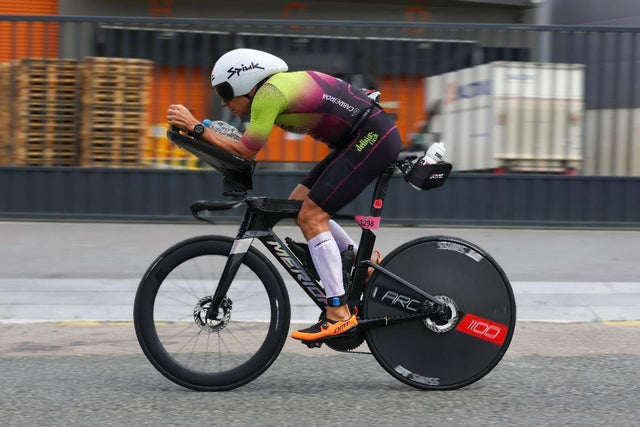
If you ride with aerobars, add one more rule: sit up and move your hands to the handlebar before letting go with one to eat, and do it on quiet straights. The aero position is very efficient, but it isn't where you control the bike best with one hand. We cover how to get comfortable in that posture in how to get used to the aero position, and where to put your bags without spoiling the handling in how to load your bike for bikepacking.

What you eat before setting off decides how full your tank is when you start. Three basic guidelines:
Riding fasted has its place in some very specific training plans. Heading out like that on a long, demanding ride is setting a date for your bonk.
The digestive system adapts. People who practise eating during training gradually tolerate more with less discomfort; people who only eat seriously on event day usually discover their stomach's limit at the worst possible moment. Two tips repeated in every serious guide:
With low glucose you think less clearly and react more slowly. Staying on the road, with traffic and making clumsy decisions, is the real risk. Get well off the road before doing anything else.
A gel, a sugary drink, sweets or a soft drink from the nearest bar. Solid, slow food isn't what you want now: you want something that gets there fast. Have water with it.
Give yourself ten or fifteen minutes before setting off again and do it at a very easy pace, carrying on eating little and often until the end. The improvement is usually real but partial: you won't get your early legs back that day. If you can, shorten the ride.
If there's no improvement at all after eating, or you get severe confusion, fainting, chest pain or symptoms that don't fit, don't treat it as a bonk: get help and call the emergency services (112 in Europe). And if you have diabetes or take medication that affects glucose, your on-bike fuelling strategy should be set by your doctor, not a blog article.
All three can stop you in your tracks, but they aren't solved the same way. This table is a guide:
| Sign | Bonk | Dehydration or heat | Accumulated fatigue |
|---|---|---|---|
| How it appears | Suddenly, within minutes | Gradually, and worse the hotter it is | Gradually, over the ride or over several days |
| What you notice in your head | Mental fog, irritability, dizziness | Headache, intense thirst, dizziness when standing up | Lack of motivation, but your head works |
| Other clues | Ravenous hunger, cold sweat, shaking | Dry mouth, scant dark urine, cramps | Heavy legs that don't improve after eating |
| What helps | Fast carbs: improvement within 10-15 minutes, though partial | Shade, stopping and drinking with salts | Rest, sleep and reducing training load |
It's a sudden drop in performance that occurs when the body's carbohydrate stores (muscle and liver glycogen) run out and blood glucose starts to fall. Because the brain relies mainly on glucose, it isn't just your legs that fail: dizziness, cold sweat, irritability and difficulty concentrating also appear. It's avoided by eating regularly on long rides.
It depends on the duration. On rides of less than an hour you usually don't need to eat. Between one and two and a half hours, the reference recommendations suggest 30 to 60 grams per hour. For efforts of more than two and a half hours you can go up to around 90 grams per hour in competition, with products that combine glucose and fructose and a trained stomach. For most leisure rides, 40-60 grams per hour is usually enough.
After taking fast-absorbing carbs, you can usually set off again at an easy pace within ten or fifteen minutes. The improvement is partial: you won't get your early performance back that day, so keep eating little and often and, if possible, shorten the ride. If eating brings no improvement at all, get help.
Both have their moment. Solids, such as bars, fruit or a small sandwich, go down better in the first hours and on easy stretches. Gels and carb drinks digest faster and fit better towards the end, on intense sections or in the heat. The most important thing is to use only what you've already tried in training.
Usually not, if you've eaten normally before setting off: enough water is sufficient. It's different if you ride fasted, if the ride is very intense or if it goes on longer than planned. In that case, carrying a gel or a bar is cheap insurance.
At CarboXtrem we make carbon parts and 3D-printed lattices for the points where your body touches the bike. We don't sell gels or bars, and no component, including ours, replaces eating on time.
What equipment can do is remove excuses. If you ride for hours on aerobars, having your drink up front and being able to drink without taking your arms off the rests turns "I'll drink later" into a sip every few minutes; and if you carry a carb drink in the bottle, that sip is also fuel. That's what we designed the Bottle Holder Kit for, compatible with all CarboXtrem aerobar models.
This article is for general information and does not replace individual advice from a sports dietitian-nutritionist or your doctor.
Topics