CarboXtrem TT Aerobars
€890,00
CARBOXTREM
Pre-launches, custom-fit tips and offers for your bike. No spam: only what is worth it.
Already have an account? Sign in21/08/2026 · Alfonso Lopez Pe

On almost any saddle's spec sheet there's one figure that gets read before the rest: grams. It's the easiest number to compare, the one that appears in magazine tables and the one used to justify half the price. And it's by far the most poorly interpreted.
The reason is simple: a saddle's weight isn't an isolated property, it's the result of several design decisions taken earlier. You can reach a low figure in many ways, and they don't all cost the same when you've been sitting on it for three hours. Two saddles can read the same on the scales and behave completely differently at kilometre 90, because one has lost weight by getting smarter on the inside and the other has simply got smaller.
That's what this guide is about: where a saddle's grams really come from, what you pay for each cut and how to read the spec sheet so you don't end up comparing two things that can't be compared.

A conventional saddle is an assembly of four parts, and each one has its share on the scales.
These are the two tubes by which the saddle is clamped to the seatpost. On entry-level models they're steel; as you go up the range they move to light alloys and, in racing, to carbon fibre. It's the area where it's easiest to cut weight without changing anything the rider feels, which is why it's usually the first to change. Watch out for a practical detail: carbon rails usually have an oval section and need a compatible seatpost and controlled clamping torque.
This is the casing that gives the saddle its shape and largely decides how it flexes. A reinforced composite shell weighs little and allows stiffness to be tuned by zone. Here the saving is also relatively cheap in terms of comfort, as long as the resulting stiffness is still right for the rider's weight.
This is where it gets interesting. Foam is solid material: it takes up volume and weighs in proportion to that volume. Cutting weight by removing foam is immediate, but it's also the cut you feel most, because it directly affects what's between your sit bones and the rigid base. Many racing saddles are hard not because of a biomechanical decision, but because the quickest way to make them light is to put almost nothing inside.
The outer layer provides grip and protects the foam, and it adds far fewer grams than people assume. Its role in total weight is small, but its role in durability isn't: it's the part that tears, and once it tears, the foam starts absorbing water and sweat.
There's a fifth route that is almost never explained on the spec sheet, although it's plain to see when you compare photos: making the saddle shorter and narrower. Less surface means less shell, less foam and less cover all at once, so it's the most effective lever of all for bringing the figure down. And also the one that most changes what you feel, because the surface being trimmed is exactly the one that spreads your weight.
A saddle doesn't hold your weight: it spreads it. You apply a more or less constant force over a certain surface, and what your tissues feel isn't the total force, but how much force falls on each square centimetre of support.
That relationship is not up for debate: if you keep the load and reduce the area, pressure goes up. You don't need any lab figures to understand it; it's the reason a backpack with wide straps is more comfortable than one with cords, even with exactly the same contents.
Applied to the saddle, it means trimming the outline has a double cost. First, because there's less area available for the same load. And second, because on a narrow saddle the sit bones can end up resting on the edge of the useful area, or outside it altogether, so the weight ends up on soft tissue that isn't designed to bear it.
The symptom doesn't appear at first. On a short ride, almost any saddle is bearable. The problem shows up on long rides, when you've spent half an hour shifting position every few minutes without quite knowing why, or when you end up standing on the pedals more out of necessity than pace. If that sounds familiar, you might first want to check the fit side in our guide to saddle height and the signs you have it wrong, because a badly adjusted position produces similar symptoms.
If foam is heavy because it's solid and trimming the outline costs comfort, there's a third route: changing what the inside of the padding is made of.
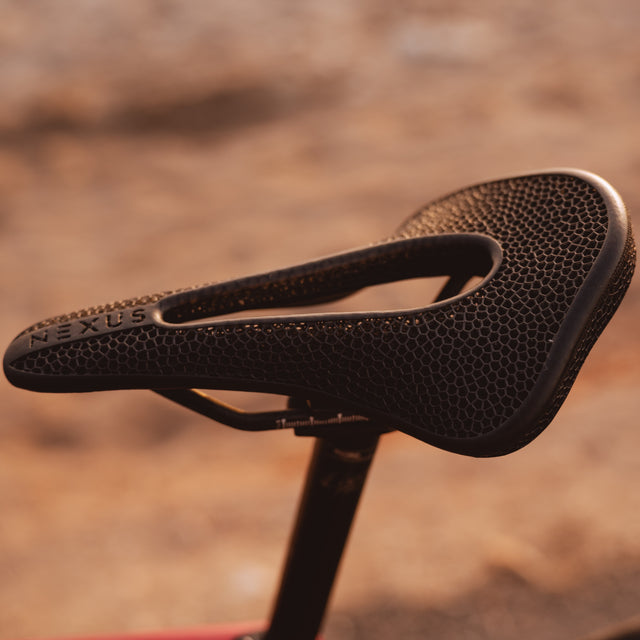
That's where additive manufacturing comes in. A three-dimensional lattice —a structure of thousands of interconnected hollow cells— can fill the same volume as foam with a fraction of the material. The air between cells weighs nothing, and yet the whole still has padding height, the ability to deform under load and the ability to spring back when you stand up.
There are two consequences that go beyond the scales. The first is that a cellular structure can be tuned zone by zone: where the sit bones rest you want a different response from the saddle's nose, and that can't be done with homogeneous foam. The second is that an open structure doesn't behave like a closed sponge with sweat and water, something we cover in more detail in the article on traditional foam versus 3D lattice.
In other words: the material is removed from the inside, where there's too much, not from the outline, where it does the work.
The NEXUS 3D Carbon Saddle was designed with exactly this approach. It weighs 146 grams in a 240 × 140 mm format, and the two figures need to be read together: it's a racing weight without the surface penalty that usually comes with it. Compared with the usual market reference, many saddles around that weight achieve it in considerably smaller formats.
The part is 3D printed using Carbon's Digital Light Synthesis™ technology in EPU 41, an elastomeric polyurethane from Carbon. The structure is a Voronoi lattice, an irregular-cell geometry that spreads load and absorbs vibration without needing to add volume.
And there's a second layer of customisation that doesn't show up on the scales: the density of that lattice isn't universal, it's calculated from two of the rider's figures. Weight, which determines how much the structure should give, and sit bone distance, which positions the area that really has to provide support. If you don't know yours, it takes two minutes to measure with a piece of cardboard: we explain it step by step in how to measure your sit bone distance.
| Detail | NEXUS 3D Carbon Saddle |
|---|---|
| Weight | 146 g |
| Dimensions | 240 × 140 mm |
| Technology | Carbon DLS (Digital Light Synthesis™) 3D printing |
| Material | EPU 41, Carbon elastomeric polyurethane |
| Structure | Open-cell Voronoi lattice, density tuned by zone |
| Customisation | According to rider weight and sit bone distance |
| Manufacturing | Made to order, in Europe |

Four quick checks so the figure means something:
A weight without dimensions is incomplete information. Length and maximum width should be on the same spec sheet; if they aren't, that's a sign in itself. Comparing grams between a short, narrow saddle and a full-format one tells you nothing.
If the grams come from carbon rails and a well-designed shell, you've saved weight without losing comfort. If they come from the saddle being a board with a minimal layer of foam, you're paying for it in pressure.
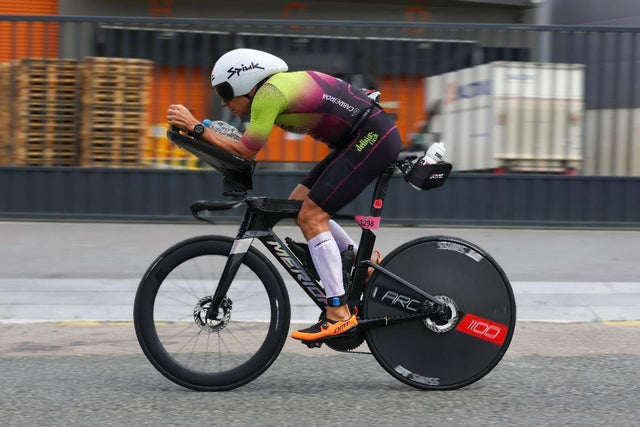
For a 40-minute time trial, a minimal saddle can make perfect sense. For sportives, gravel, marathon or ultra-distance, the support surface and how the padding behaves matter far more to the final result than twenty or thirty grams.
When those grams are compared with the total weight of bike, rider, bottles and tools, the difference between two saddles is practically irrelevant to performance. What isn't irrelevant is finishing the ride comfortable or finishing it counting the kilometres left. We talk about what a carbon component or a printed part can really withstand in weight limits of carbon components and 3D-printed parts.
| If your priority is… | Look at… | Be wary of… |
|---|---|---|
| Performance over short distances | Weight and stiffness of the whole | Extrapolating that choice to long rides |
| Long rides and sportives | Support surface and padding behaviour | Minimal saddles without dimension data |
| Pressure problems or numbness | Useful width, central channel and fit | Adding more foam as an automatic fix |
| Durability | Materials that recover their shape and resist water and sweat | Thin covers over cheap foam |
| Absolute minimum weight | Rails and shell | Savings achieved by trimming the outline |
It depends mainly on the rails, the shell, the type of padding and the size. A stock saddle weighs considerably more than a racing one, and within the high end the differences are almost always explained by the rail material and how much surface the saddle has. That's why a weight without the dimensions next to it is incomplete information: the NEXUS, for example, weighs 146 g in a 240 × 140 mm format.
Not necessarily: it depends on where the grams have been removed. If the saving comes from the rails or the shell, comfort needn't be affected. If it comes from trimming the support surface or leaving the padding to a minimum, then yes, you pay for it.
Because a saddle doesn't hold your weight, it spreads it. The less useful surface there is, the more pressure each support point bears. And on a narrow saddle the sit bones can end up on the edge of the support area, so the weight ends up loading soft tissue.
Because the padding isn't solid material. Instead of foam it has a three-dimensional lattice of hollow cells that fills the same volume with much less material. The grams are saved inside the structure, not in the outline.
It weighs 146 grams and measures 240 × 140 mm. It's 3D printed with Carbon's DLS technology in EPU 41, with an open-cell Voronoi structure and density tuned to the rider's weight and sit bone distance.
Against the total weight of bike and rider, the difference between two saddles is barely noticeable in performance. Where you do notice it is over the hours. Pay for pressure distribution and padding that lasts; let the weight be a consequence of the design, not the goal.
Cutting a saddle's weight is easy if you take the quick route: remove somewhere to sit and the scales thank you for it. The hard part —and the one that really makes a difference on long rides— is keeping the support surface and removing material from the inside, where it isn't needed.
If you're comparing saddles right now, put the dimensions next to the grams before you decide. And if you want to see how that equation is solved with additive manufacturing, take a look at the NEXUS 3D Carbon Saddle: it's made when you order it, with your weight and your sit bone distance.
Topics