CarboXtrem TT Aerobars
€890,00
CARBOXTREM
Pre-launches, custom-fit tips and offers for your bike. No spam: only what is worth it.
Already have an account? Sign in03/08/2026 · Alfonso Lopez Pe

It reaches us by private message more often than you'd imagine, and almost always in the same apologetic tone: "I weigh 95 kilos… will this work for me?". The doubt is completely reasonable. Half the cycling industry communicates as if every rider weighed 68 kg, and anyone above that standard ends up looking at every lightweight component with suspicion: is it for me, or will I break it?
In this article we answer that question seriously: where the weight limits you see on spec sheets come from, why they exist on mass-produced components, and what changes —fundamentally— when the part doesn't come out of a warehouse but is made from your data.
When a manufacturer produces thousands of identical units of a handlebar, seatpost or saddle, it has to make an awkward decision: the same part has to work for a 55 kg rider and a 110 kg rider. Faced with that range, there are only two ways out:
Neither option is a flaw of carbon as a material; they're the rules of the mass-production game. The weight limit on a spec sheet doesn't describe what the material can take: it describes the compromise the manufacturer reached so it could sell the same part to everyone.
Carbon fibre works beautifully when loads go in the direction its plies were oriented for. That's why the key to a carbon part isn't just the material, but the lay-up: how many plies it has, how they're oriented and who decides that scheme. If you want to dig deeper into what fibre grades mean, we cover it in T700, T800 and T1000 carbon: what those numbers mean.
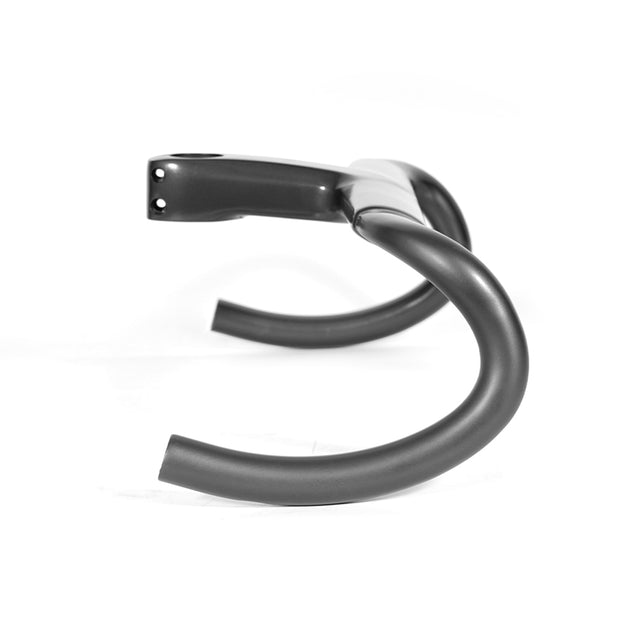
At CarboXtrem, carbon structures —like the body of our aero aerobars— are laid up by hand, piece by piece, with Sato-brand fibre (T1000 grade on high-end models). Laying up to order has a direct consequence for the topic at hand: the part isn't made before we know you. It's made afterwards. Your measurements —and your build— are part of the order, not an unforeseen load the part has to cope with.
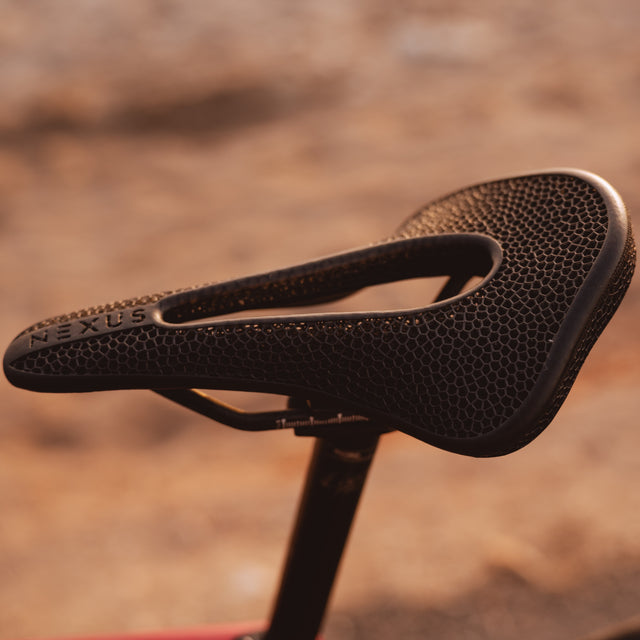
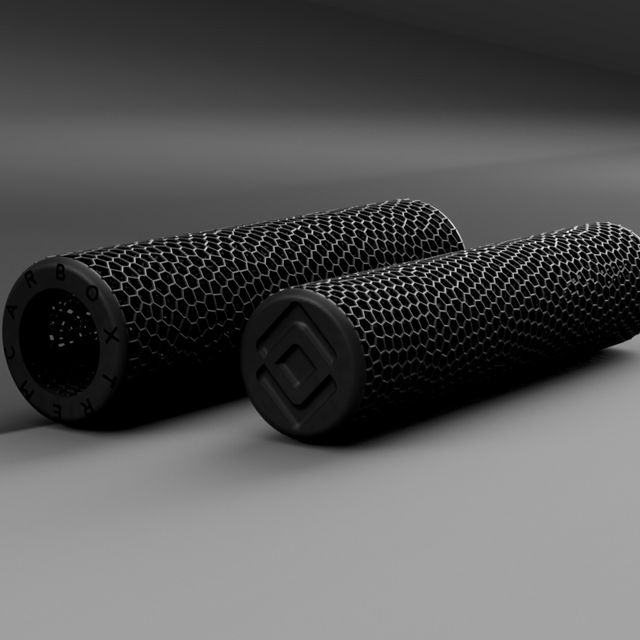
The other half of our range is 3D-printed contact parts: the NEXUS 3D Carbon Saddle, the Race Days grips and the aerobar pads. They all share the same principle: an open-cell lattice printed with Carbon's DLS technology in EPU, Carbon's own elastomeric polyurethane.
Here is the detail that answers the article's question: that lattice doesn't have a single hardness. The stiffness of each zone depends on the geometry of its cells, and that geometry is calculated in the design for each order. A 60 kg rider and a 110 kg rider don't get "the same saddle that copes more or less": they get two different lattices, each one sized to deform just the right amount under the weight that will use it.

That's why, when you configure the NEXUS in the shop, the first thing we ask for isn't your size: it's your average weight. The product's actual drop-down goes from 55 kg up to the 100–120 kg bracket. It isn't a sales add-on; it's the input data for the design of your lattice. The second figure is your sit bone distance —if you don't know it, there is literally an "I don't know, help me choose" option, and we explain how to measure it in this guide to measuring your sit bones.
| Feature | Detail |
|---|---|
| Dimensions | 240 × 140 mm |
| Weight | 146 g |
| Core | 3D lattice printed in EPU 41 resin (Carbon DLS technology) |
| Base | Laminated carbon fibre |
| Per-rider configuration | Average weight (from 55 kg to 100–120 kg) and sit bone distance (70–160 mm) |
| Resistance | Water, sweat, UV rays and prolonged wear |
Notice the apparent contradiction: 146 g and yet configuration brackets up to 100–120 kg. That's the advantage of calculating the structure for each rider instead of adding material "just in case": the weight of the part doesn't grow with the manufacturer's fear, it only grows where your body will demand it.

After years of making and repairing components, we can tell you where we see real problems, and they rarely have anything to do with the rider's weight:
In other words: if your component has been calculated for your weight and you mount it at the correct torque, your weight is a design variable that's already been solved, not a pending risk.
If you're around 100–120 kg, you're well within the configurable range of the NEXUS and our other lattices: select your real weight bracket —without rounding down, the lattice works better with honest data— and your part will be printed with the density that suits you. If you're above that bracket, message us before ordering: because we make to order, we can look at your specific case instead of pointing you to a fixed table.
And one more fact that answers the initial distrust better than any argument: our CarboXtrem Aero aerobars are backed by a lifetime warranty. A manufacturer doesn't sign up to that if its plan is for the material to be pushed to the limit.
Yes. The NEXUS is configured by rider weight and its selector goes up to the 100–120 kg bracket. The lattice is printed with the density calculated for that weight; it isn't a single part that "adapts" better or worse.
Not if it's sized for that weight: the cells are calculated to give in a controlled way under the expected load and recover their shape, and Carbon's EPU resists water, sweat, UV rays and prolonged wear. If you're interested in the mechanics of support, in soft or firm saddle? we explain why more padding isn't more comfortable.
Because the same part has to work for very different riders. The manufacturer sizes it for a middle range and caps it on the spec sheet. It's a compromise of mass production, not a property of carbon.
For the saddle, your weight bracket and sit bone distance. For the aerobars, your measurements: each aerobar is adapted to the length of your arm and places your wrists at a 50º angle.
The next time you see a "maximum weight" on a spec sheet, remember what it really means: that part was made without knowing who would use it. At CarboXtrem we work the other way round — your data first, then the part. Configure your NEXUS 3D Carbon Saddle with your real weight, or message us and we'll build the conversation around your case, not the average.
Topics