CarboXtrem TT Aerobars
€890,00
CARBOXTREM
Pre-launches, custom-fit tips and offers for your bike. No spam: only what is worth it.
Already have an account? Sign in01/08/2026 · Alfonso Lopez Pe

Few parts are chosen as quickly as grips. You look at the colour, maybe the brand, and into the basket. And yet, along with the saddle and shoes, they're one of only three places where your body touches the bike: steering, braking and every hour of vibration on every ride pass through them. The question almost nobody asks seriously —thin or thick?— has more to it than it seems, because grip thickness changes how your hand works from the start of the ride to the finish.
The hand grips best the closer it is to its natural closed position. With a thin grip, your fingers wrap almost completely around the handlebar: the grip is secure with little force, feedback from the terrain comes through clearly and the wrist works in a compact posture. In exchange, there's less material between your palm and the aluminium or carbon of the handlebar, so pressure is concentrated on a smaller area.
With a thick grip the opposite happens: more contact surface and more cushioning material, but the hand is more open. An open-handed grip demands more finger and forearm strength to achieve the same hold, and that extra effort, multiplied over hours, is fatigue you don't blame on the grip… until you change grips.
The time-honoured guideline —big hands, thick grip; small hands, thin grip— is a reasonable starting point, but it falls short as soon as gloves, discipline and hours come into play. An XC racer with big hands may prefer a slim grip because they prioritise control on technical descents; someone riding long marathons may want more surface even if their glove size says otherwise. The right thickness isn't a size: it's a balance between control, comfort and fatigue for the way you ride.
Here's the underlying problem: in a conventional grip, the cushioning lives in the thickness. A mass of rubber or foam can only absorb vibration if there's enough of it, so the comfortable grip tends to be the fat grip, and the grip with good feel tends to be the spartan one. For decades the choice has been exactly that: control or comfort, choose which hand you want to have at the end of the ride.

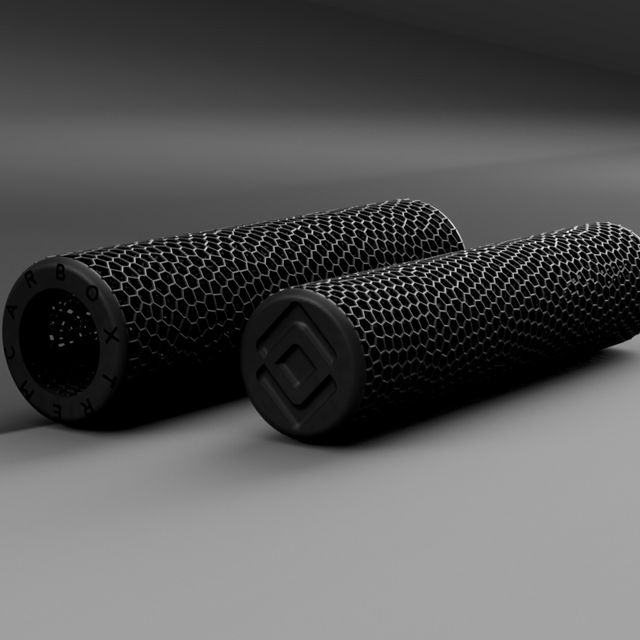
The Race Days tackle the dilemma through geometry. Instead of a continuous mass of rubber, the grip is a 3D printed Voronoi lattice: thousands of hollow cells that deform under impact and instantly recover their shape. Absorption doesn't depend on piling up thickness but on how the structure gives, so the grip can keep a slim profile —with the feel and control of a performance grip— and behave like a much plusher one when the terrain hits.
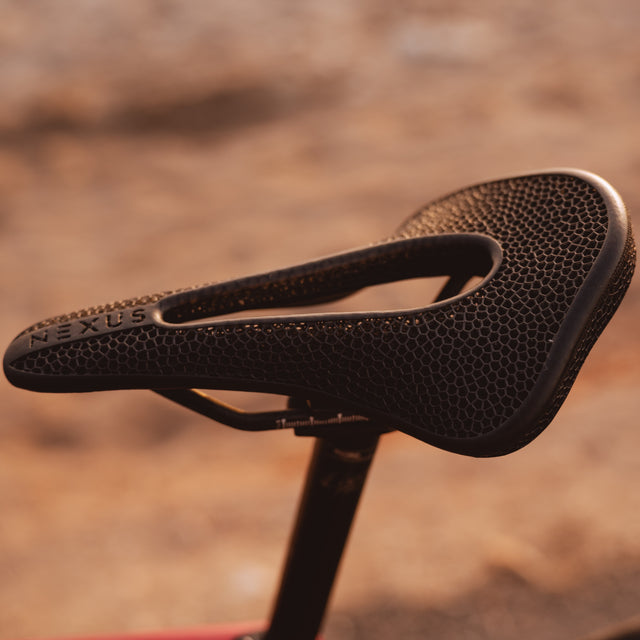
The material plays its part too. They're printed using Carbon DLS technology in EPU 41, the elastomeric polyurethane Carbon developed precisely for parts that must flex millions of times without degrading. It's the same type of lattice used in our NEXUS saddle and the pads on our aerobars: it gives under load, springs back into place and doesn't lose its properties with heavy use. In fact, Carbon itself featured these grips as an official success story in the sports sector.
And there's a side effect you'll appreciate in summer: being an open structure, air circulates and sweat doesn't get trapped between palm and grip. The cell texture keeps gripping even when your hand is soaked — if you ride a lot in water and mud, you'll want the full guide to wet grip.
Tingling doesn't always call for more rubber: it usually calls for better pressure distribution. If your current grip is thin and solid, the load concentrates on two or three points of the palm, and that's where numbness appears. Before jumping to the fattest grip in the shop, read why hands go numb on the bike: the solution lies more in how the material gives than in how bulky it is.
If you finish descents with loaded forearms, your grip may be too big for you (open hand = more strength needed to hold on) or it may slip and you're compensating with pressure. A slimmer profile with good texture will let you grip relaxed.
The more technique the terrain demands, the more valuable direct feel becomes: in XC and on broken trails, a slim grip communicates better what the wheel is doing. On marathons and long rides on fire roads, the priority shifts towards sustained comfort. The advantage of a lattice that cushions through its structure is that it reduces what you have to sacrifice in both cases.
Gloves add their own padding and their own effective thickness. If you ride with padded gloves, a thick grip on top can leave your hand too open; if you ride without gloves, the grip's texture becomes your only interface and it should grip by design, not by pressure.
| Feature | Detail |
|---|---|
| Structure | Open-cell 3D Voronoi lattice |
| Material | EPU 41, Carbon elastomeric polyurethane |
| Manufacturing | Carbon DLS (Digital Light Synthesis) 3D printing |
| Length | 130 mm |
| Inner diameter | 22.2 mm (MTB flat handlebar standard) |
| Use | XC, marathon, trail and e-MTB with a flat handlebar |
| Recognition | Success story officially featured by Carbon3D |

No. Because the cushioning comes from the cell structure rather than the thickness, the grip keeps a slim performance profile and still absorbs the vibration that would normally require a much thicker grip.
No: they're designed for standard MTB flat handlebars (22.2 mm inner diameter) — XC, marathon, trail and e-MTB. Road and gravel bikes use bar tape.
Carbon's EPU 41 is designed to flex and recover millions of times: the grip keeps its properties with heavy use, without the deformation typical of foam.
Either way. Without gloves, the texture grips by design even with sweat; with gloves, the slim profile stops your hand from being too open.
If you've spent years jumping from grip to grip —thin ones punish you, fat ones tire you out—, the problem wasn't you: it was the material. A 3D printed lattice cushions through its structure, grips through its texture and keeps the diameter your hand wants to close around.
Topics