CarboXtrem TT Aerobars
€890,00
CARBOXTREM
Pre-launches, custom-fit tips and offers for your bike. No spam: only what is worth it.
Already have an account? Sign in09/09/2026 · Alfonso Lopez Pe

There's a very widespread idea about road safety worth dismantling right away: that visibility is a switch. Either they see you or they don't. In practice it doesn't work like that. They almost always end up seeing you; the important question is from how many metres away.
Think about it from the driver's seat. The driver doesn't just have to register that there's something on the shoulder. They have to interpret what that something is, work out how fast they're closing on it, decide whether to overtake or wait, check the oncoming lane and, finally, turn the wheel. All of that takes time. When detection happens late, the whole sequence gets compressed and what should be a calm overtake turns into a rushed manoeuvre.
That's why visibility isn't measured in "they saw me or they didn't", but in metres of warning. And there are two times of day when those metres shrink dramatically without you noticing anything odd, because from the bike everything still looks perfectly clear. They're also the two most beautiful times of day: dawn and dusk.

When the sun is very low —the first hour of the morning and the last of the evening— the light arrives almost horizontally. That means it shines straight into the field of view of anyone driving towards the sun, without the car's sun visor fully blocking it. From there, three effects follow one after another.
With a very intense light source in the field of view, the eye protects itself: the pupil contracts and overall sensitivity drops. As a result, everything not lit by that sun is perceived as a dark, uniform mass. A cyclist riding on the shoulder, with the sun in the driver's face, disappears into that mass.
Low-angle light creates long shadows. A hill road at that time of day is a succession of bright stretches and shaded stretches, and the eye needs a moment to readjust each time it moves from one to the other. That moment of readaptation is exactly when metres of detection are lost: inside the shade, for a few seconds, you see much less than you think.
Early in the morning, the moisture still hanging in the valley blurs the edges of everything at medium distance. It doesn't have to be thick fog: light haze is enough for silhouettes to lose definition right in the range where you want to be detected, those first hundred or two hundred metres.
The practical conclusion is uncomfortable but clear: the time of day when riding is at its best —cool, calm, with little traffic— is also the time when you need to be most deliberate about visibility.
If low-angle light is a problem, the stretch between sunset and nightfall is the bigger problem. And for a purely human reason: you can still see. Because you can still see, a lot of people don't switch anything on. Neither cars, fully, nor bikes.
What happens during that time is that the visual system is switching operating modes. In plenty of light we work with the part of the retina specialised in detail and colour. In very low light, the part that works in the half-dark comes into play, which is much more sensitive but doesn't distinguish colour and has less acuity. Between one situation and the other there's an intermediate phase, and that intermediate phase coincides exactly with twilight.
The subjective feeling is that "there's still plenty of light", because the brain compensates very well. What it doesn't compensate for is the loss of edge definition and colour. Objects are still there, but they become harder to separate from the background and to identify. And slow identification is, once again, late detection.
This is the most useful part of the whole article. Visibility doesn't depend on the colour of your clothing in the abstract, but on the difference between you and whatever is behind you. A black jersey in front of a wall of forest at half past eight in the evening isn't just hard to see: there's no boundary the eye can draw. That same black jersey silhouetted against the sky on a rise is perfectly visible.

From the above you can see why the classic "wear something bright" only half works. Fluorescent yellow is excellent against dark tarmac or green vegetation, and much worse against a field of dry stubble with the light behind it. No colour always wins, because the background keeps changing: forest, rock, sky, wall, crops.
What does always win is having elements that generate their own contrast, regardless of the background. That's exactly what two things do: a light, which emits; and a reflector, which bounces back the light from the headlights of the approaching car. Neither depends on whether there's a pine forest or a wheat field behind you.
Having your rear light on in broad daylight when the sun is low is probably the gesture with the best effort-to-result ratio there is. It takes two seconds and works precisely when the driver has the sun in their face and everything else has turned into a grey silhouette.
Each mode does a different job, and it's useful to understand which. A flashing light grabs attention: the human eye is very good at detecting things that change. A steady light, on the other hand, is what allows distance and closing speed to be judged, because the driver can follow it continuously as they approach. A point that appears and disappears is harder to place in space.
That's why, if you carry two rear lights, the most complete combination is one steady and one flashing: one makes you noticed and the other makes you measurable. If you only carry one, on open roads with fast traffic the steady light is usually the most informative option, while flashing wins in busy urban environments full of stimuli.
A rear light tilted towards the ground lights up the tarmac just behind your wheel and little else. One aimed at the sky is wasted. The simple rule is to keep it roughly horizontal to the ground, so its useful beam matches the eye height of the approaching driver. It's worth checking with the bike moving, not just propped up, because the angle of the seatpost changes the real angle.
And with the front light, a note on road manners: on narrow two-way roads, a very powerful front light on flashing mode and aimed high dazzles oncoming traffic. What you gain on one side you lose on the other.
If you take only one practical idea from this whole article, make it this one: put reflective material low down, on your ankles and feet.
The reason is that the human visual system is extraordinarily good at detecting patterned movement, and particularly the movement of a human body. A stationary bright spot on the shoulder could be a post, a letterbox, a crash-barrier reflector or a road sign reflector. Two bright spots moving up and down in circles can't be anything else: they're legs pedalling.
The difference isn't intensity, it's identification. The driver doesn't just detect you sooner: they understand sooner what they're looking at, and so they start the sequence of deciding and moving over sooner. Overshoes with a reflective band, a few strips on your ankles or simply light-coloured socks contribute far more than their size suggests. The same goes for pedals with built-in reflectors, which people often remove for looks and which, in motion, are one of the most effective elements on the bike.
| Time of day | What goes wrong | What to do |
|---|---|---|
| Dawn, low sun | Direct glare for the driver and long shadows | Steady rear light on, clothing with contrast, ride an especially straight and predictable line |
| Mid-morning and midday | Little risk of late detection due to light | Rear light optional; watch out for tunnels and areas of deep shade |
| Evening with low sun | Same as dawn, with more traffic | Rear light on; avoid stretches with the sun right behind you if there's an alternative |
| Twilight (the worst) | "You can still see": nobody switches on and the eye loses sharpness and colour | Front and rear lights on, reflective material on ankles and feet |
| Full darkness | Less deceptive: everyone switches on | Front light with a useful beam, steady rear light, side reflectors on the wheels |
| Fog or haze | Blurred edges at medium distance | Flashing light as well as steady; reflective material loses effectiveness with moisture in the air |
Being detected early is of little use if you then do something the driver didn't expect. In low light, a clean line is worth as much as a rear light: holding a steady line, not weaving in and out of the shoulder dodging potholes only you can see, and signalling changes well in advance.
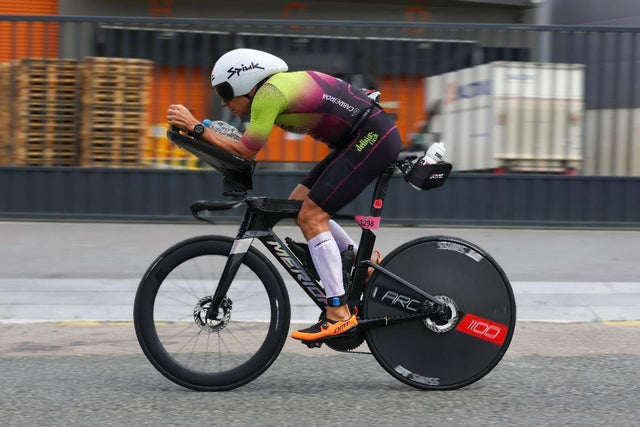
This has an implication for posture that gets overlooked. In a very aggressive position, with your head down, your own field of view shrinks just when the road surface is hardest to read. If you ride at night or at dawn on aerobars, it's worth bearing in mind: the aero position is very fast, but it isn't the position from which you can best anticipate a pothole in the half-light. We cover it in detail in how to get used to the aero position.
And if the ride is long and will end in the dark —a bikepacking route, a sportive lasting many hours—, the lighting plan is part of the kit plan, just like water or food. It's worth thinking about alongside load weight distribution and hydration on long rides: a flat battery at nine at night is a logistics problem, not bad luck.
Keep it simple: check that the rear light has battery and is roughly horizontal; take the front light even if you're leaving in daylight if you'll be back late; put something reflective low down, on your ankles or shoes; and if your clothing is dark, add at least one element that stands out against any background. That's four things, sorted in a minute.
When the sun is low, yes: that's when the driver has the light in their face and everything backlit turns into a dark silhouette. A rear light on during the first two and last two hours of daylight is the gesture with the best effort-to-result ratio. At midday, with high, even light, it adds much less.
They do different things. A flashing light grabs attention because the eye is very good at detecting change; a steady light lets drivers judge how far away you are and how fast they're catching you, because it can be followed continuously. If you carry two lights, the most complete option is one of each. If you only carry one, on open roads the steady light is usually more informative, while in town the flashing light stands out better among so many stimuli.
Twilight, that stretch between sunset and full darkness. Because you can still see, a lot of people don't switch anything on, and at the same time the eye is changing operating mode and losing sharpness and colour. A dark object on a dark background practically loses its edges.
It depends on the background. No colour always stands out: fluorescent yellow works very well against tarmac or green vegetation and much worse against dry stubble with the light behind it. What works against any background are elements that generate their own contrast, in other words lights and reflectors.
On your ankles and feet. The circular movement of the legs is recognised as a person pedalling much sooner than a stationary point of light, which could be any object on the roadside. That faster identification is what gives the driver time to decide and move over.
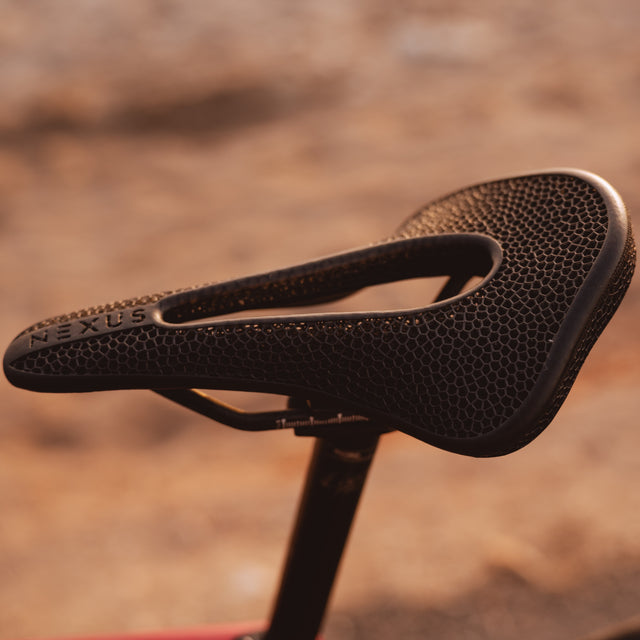
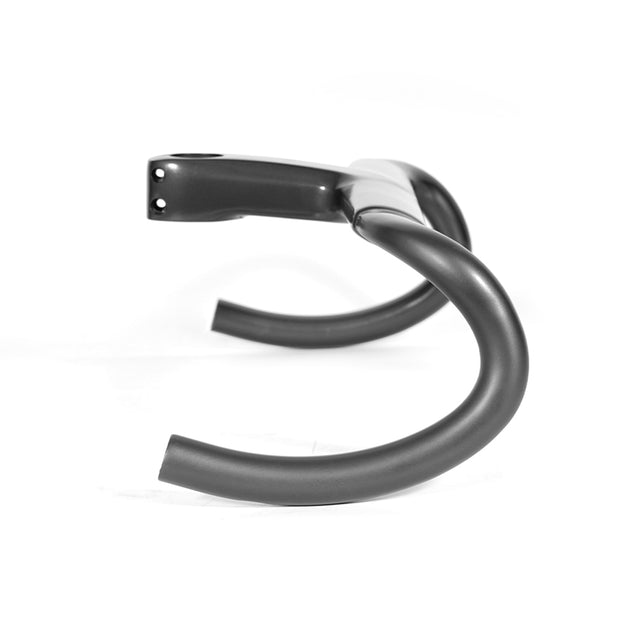
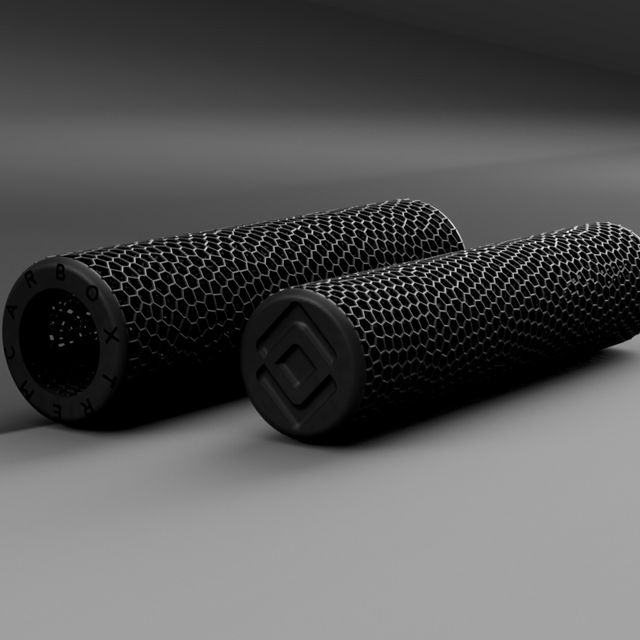
At CarboXtrem we don't make lights or reflective clothing, and this article isn't about selling them to you. We make carbon parts and 3D printed lattices for the three points where your body touches the bike, which is the ground we know well.
But position and kit only work if the ride ends the way it should. And in September, with the evenings suddenly drawing in, the difference between a perfect ride and a scare is rarely in the equipment: it's in whether someone saw you with a hundred metres to spare or with twenty.
Topics