CarboXtrem TT Aerobars
€890,00
CARBOXTREM
Pre-launches, custom-fit tips and offers for your bike. No spam: only what is worth it.
Already have an account? Sign in19/08/2026 · Alfonso Lopez Pe

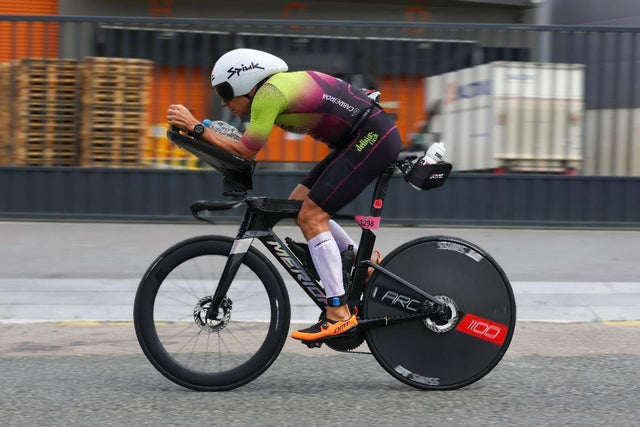
You can have huge engine in your legs, but if after an hour and a half in the aero position your hands go numb, your elbows burn and you have to sit up for air every few kilometres, your time trial or your triathlon bike leg falls apart on its own. The aero position isn't won by whoever gets into it: it's won by whoever can hold it.
And the point where almost everyone breaks isn't the legs or the back: it's the forearm and elbow resting on the aerobar pads. That is where a large part of your weight sits for hours, and that is where a bad pad ruins the experience. In this article we explain why it happens and how we solve it with our 3D lattice pads for triathlon and road aerobars.
Numbness and tingling in the hands and forearms have a very specific mechanical cause: sustained pressure on nerves and blood vessels. In the aero position, much of the weight of your upper body rests on a small surface —the elbow and forearm area— supported by the pad. If that pad concentrates the load on one point, three things happen:
It is the same mechanism that causes numb hands on the handlebar, just moved to the forearm. And the conceptual solution is identical: spread the pressure instead of concentrating it.
Most aerobars come from the factory with simple EVA rubber or foam pads. At first they seem comfortable, but they have two underlying problems:
The foam compresses under your weight until it stops cushioning: there comes a point where you feel the rigid base of the bracket through the pad. The longer the effort, the sooner it happens. And over time the foam packs down and loses its rebound, just as happens to a foam saddle.
A uniform foam doesn't distinguish between the area where your elbow bone rests and the area where your forearm lies: it cushions the same everywhere. And being a closed material, it traps sweat and heat exactly where it feels worst during a hard effort in the sun.
Our large-format pads aren't a block of foam with a nice shape: they are a 3D-printed lattice structure, made with Carbon DLS technology and EPU elastomeric material. Instead of a solid material, they are a three-dimensional network of hollow cells that behaves very differently.
By designing the geometry cell by cell, we can make the lattice softer where you put your weight (to absorb vibration and pressure) and firmer at the edges (to give you stability and control). Foam can't do this: it is the same throughout its volume. A 3D lattice can.
The lattice structure recovers its shape again and again and doesn't compact with use like foam. That means the pad that gives you comfort at kilometre 10 still gives it to you at kilometre 90. Hour 4 feels like hour 1.
Because it is an open structure, air circulates through the lattice. It doesn't trap sweat or heat like a closed foam, a detail you really appreciate in long-distance triathlon and on hot days.
A pad with a larger contact surface spreads the same weight over more area: pressure per square centimetre drops and you relieve tension in your neck and shoulders. Fewer hot spots, less need to reposition. (And if you race on a time trial bike, there is also a large-format version designed specifically for TT base bars.)
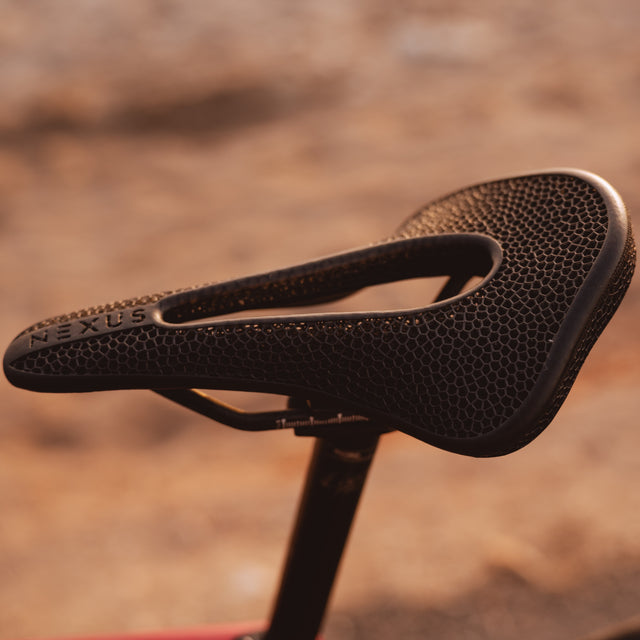
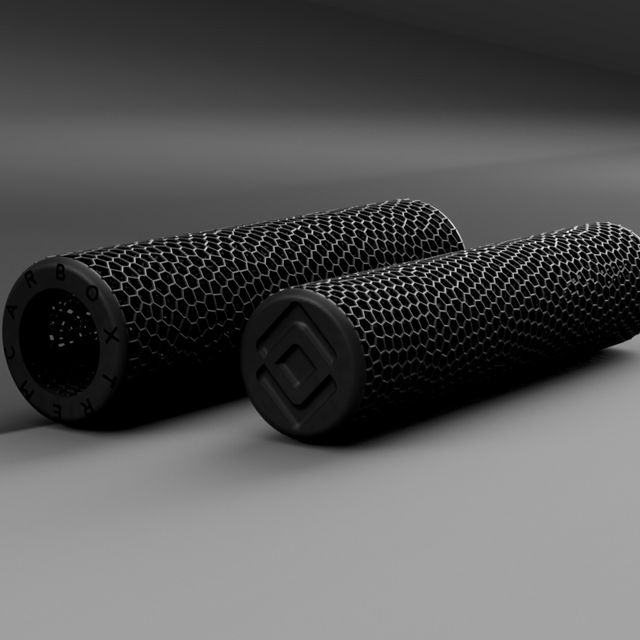
The EPU material of the lattices is biocompatible and hypoallergenic, designed for prolonged contact with the skin without irritation. It is the same type of material and process we use in our NEXUS 3D saddles and our Race Days grips: high-performance contact technology applied to every point where your body touches the bike.
| Feature | Detail |
|---|---|
| Manufacturing | 3D printing, Carbon DLS technology, made in Europe |
| Material | EPU (elastomer) lattice, biocompatible and hypoallergenic |
| Cushioning | Variable density by zone: soft where you load, firm where you stabilise |
| Breathability | Open structure: air circulates, no sweat build-up |
| Which bike | CarboXtrem triathlon and road aerobars (clip-on). For TT bikes, a dedicated large-format version |
| Advantage over EVA | Doesn't bottom out or pack down; spreads pressure better |
If you recognise yourself in any of these situations, the problem is almost certainly your rest:
Changing just the pads is by far the cheapest and highest-impact comfort upgrade you can make to your aero setup, without touching the bike or the handlebar.
Because the weight of your upper body falls on a small surface at the elbow and forearm. That sustained pressure compresses the ulnar nerve and reduces blood flow, and tingling and numbness appear. Spreading the pressure over a larger surface reduces or eliminates the problem.
Foam cushions the same throughout its volume, sinks until it bottoms out and packs down with use. The 3D lattice has variable density, recovers its shape without compacting and breathes because it is an open structure.
They are designed for CarboXtrem triathlon and road aerobars (clip-on). If your bike is a time trial bike with a TT base bar, there is a dedicated large-format version. If you have any doubts about your setup, message us and we'll confirm.
They are 3D printed in EPU material using Carbon DLS technology. It is biocompatible and hypoallergenic, designed for prolonged contact with the skin.
A very aero position is no use if you can't hold it. If your hands go numb or your elbows hurt on every long ride, your pads are the weak link. Swap them for 3D lattice pads and discover what it's like to ride for hours in aero without thinking about your arms.
Topics