CarboXtrem TT Aerobars
€890,00
CARBOXTREM
Pre-launches, custom-fit tips and offers for your bike. No spam: only what is worth it.
Already have an account? Sign in18/08/2026 · Alfonso Lopez Pe

Think back: you chose the frame yourself, you compared wheels for weeks and the saddle probably took you two or three attempts to get right. Now think about the grips on your bike right now. Most likely they came fitted from the factory and you haven't given them a second thought since the day you took the bike home.
It's not a silly oversight: it's because grips don't fail all at once. A tyre punctures, a gear cable frays and a brake pad squeals, so all of that goes on the maintenance list. Grips, on the other hand, degrade so slowly that your brain gets used to the loss. Nobody decides one Tuesday that their grips are worn out; they simply realise one day that they've been finishing long rides shaking out their hands for quite a while.
This guide is about spotting that process before it costs you. First, why they degrade even when they look intact from the outside. Then, the specific signs worth checking. And finally, what to look for so the replacement is a real upgrade and not just new grips as anonymous as the old ones.

A grip doesn't have an easy life. It's the only part of the bike in permanent contact with your skin, and it takes a beating on several fronts at once.
Most conventional grips are solid rubber or foam. That kind of material is compressed thousands of times per ride and, over time, loses some of its ability to recover its original shape. It's a silent ageing: the part still measures the same and keeps its colour, but it no longer responds the same way under your hand.
Sweat from your hands, traces of sunscreen, energy gels that end up where they shouldn't and degreasers that splash when you clean the drivetrain all attack the surface of the material. That's why many grips end up with a shiny patch exactly where your palm rests.
If you keep your bike on a balcony, in the garden or carry it for hours on a roof rack, ultraviolet radiation speeds up all of the above. Materials designed for outdoor use cope with it well; those that aren't harden and crack sooner than they should.
Every bump, every root and every stretch of gravel sends micro-impacts to your hands. The grip is there to absorb part of that energy, and doing so is exactly what wears it out. The more rough terrain you ride, the sooner it's time to check them.
This is the clearest sign and also the most serious. A grip that rotates under your hand when you pull on the handlebar on a technical climb, or that slides outwards with vibration, is a safety problem, not a comfort one. On a descent, a grip that moves at the wrong moment costs you control of the bike. If you've resorted to hairspray, tape or any other home remedy to hold it in place, you already have your answer.
Take the bike and look at the area where your palm rests and where your fingers fall. If the pattern is flattened and a smooth, shiny patch has appeared while the rest of the grip keeps its pattern, that grip no longer holds the same. The detail matters because it's exactly the part that does the work: the texture isn't decoration, it's what stops your hand slipping when there's sweat, rain or mud involved.
Squeeze the grip hard between your thumb and index finger. It should give and spring back. If it gives very little, feels like a rigid tube or is clearly harder than when it was new, the material has lost its properties. From then on, everything the grip no longer absorbs is absorbed by your hands and forearms.
This one is subtler, but very revealing. When a grip slips or has lost its feel, your body compensates by closing your hand more so you don't lose control. That extra effort is constant, lasts the whole ride and translates into loaded forearms much sooner than normal. If you've been getting home lately feeling like you've been hanging on rather than riding, check your grips.
Numb fingers have several possible causes —handlebar height, lever rotation, wrist angle—, but worn-out grips are almost always among them, because all the vibration they no longer filter ends up in the nerve. We cover it in depth in numb hands on the bike: why they go numb. If the tingling always appears in the same place and always from the same point in the ride, it isn't bad luck: it's a sign.
Crashes, leaning the bike against walls and rubbing during transport take their toll on the ends. A loose end cap or an open end leaves the inside exposed to dirt and water, and end caps also have a protective function that's worth keeping. A crack that's spreading won't stop on its own.
There's no official mileage after which a grip expires: it depends on the material, the terrain, how much you sweat and where you keep the bike. But if you can't remember ever changing them and the bike has a few seasons behind it, it's almost certain you're riding with less grip and less cushioning than you had on day one. The useful reference isn't the calendar, it's the comparison: when you fit new ones and notice the difference immediately, that difference is exactly what you'd been losing for a while.
Putting up with worn-out grips isn't just a matter of comfort. You lose three specific things:
In other words: it's the cheapest part on the whole bike that most changes how it feels to ride. A small change, in the right place.
Since you're going to change them, it's worth choosing them rather than repeating what you had. Here's what to look at.
It's the factor that most changes the feel and the one most often ignored. A grip that's too thin forces you to close your hand a lot; one that's too thick stops you wrapping your hand around it properly and is also tiring. It depends on the size of your hand and the type of terrain, and we cover it in detail in thin or thick grips: how to choose the ideal thickness.
This is where the options really separate. Solid rubber and foam cushion through volume: to absorb more, they have to be thicker, which moves your hand away from the handlebar and reduces feel. An open-structure part works differently, because it's the internal walls that deform and recover. It's not a marketing nuance: it changes how the grip behaves when you've been on the bike for four hours.
Grips with an aluminium clamp (lock-on) are secured with a bolt and are easy to fit and remove, at the cost of adding weight and creating a rigid zone under your hand. Push-on grips do without that metal part. Neither option is better in the abstract: what matters is that, once fitted, they don't move.
A grip that holds perfectly in the dry can become something else with rain, sweat or mud. If you often ride in changing conditions, this point matters more than any other; we analyse it in grip in wet and mud: why your grips matter more than your gloves.
Check that the replacement matches your type of handlebar. Flat handlebar grips are for MTB, XC, marathon and e-MTB; a road bike with drop bars uses bar tape, and an aerobar setup has its own support parts.

The Race Days Grips were created to tackle exactly the compromise we've been talking about: cushioning without giving up feel or control.
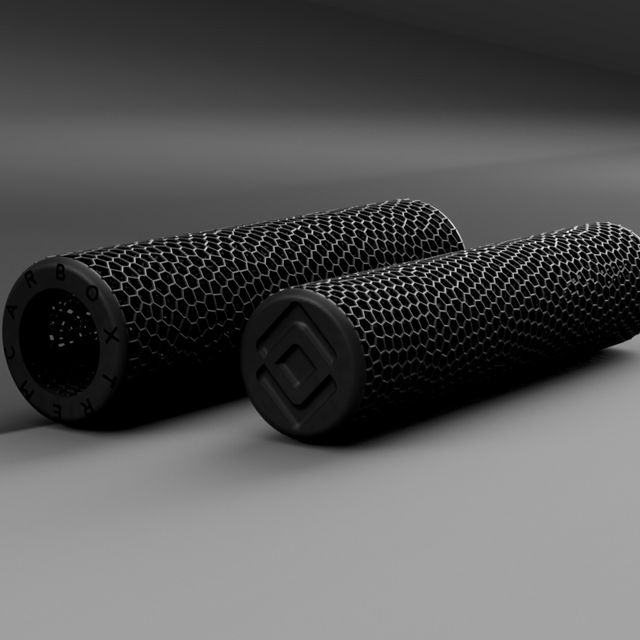
Instead of a solid mass with a pattern engraved on it, the whole part is a Voronoi structure made by 3D printing with DLS technology and Carbon EPU resin, an elastomeric polyurethane. The practical difference is that the cushioning doesn't depend on thickness, but on how the cells of the structure deform and recover; and that same open geometry acts as grip texture across the whole surface, not just on the outer pattern.
The other point is stability over time, which is what this article is about. EPU is formulated to recover its shape after repeated deformation, so the grip doesn't get flattened in the palm area with heavy use. It's the part that led Carbon to officially feature them as a success story in the sports sector.
They are grips for flat handlebars: XC, marathon and e-MTB. And they belong to the same family of 3D lattices we use at our other contact points, an approach we explain in the 3 contact points on the bike.
| Sign | What it indicates | Urgency |
|---|---|---|
| They rotate or slide | Lost clamping: control risk | Change now |
| Cracks or open end | Structural damage, dirt and water get in | Change now |
| Texture worn smooth and shiny | Loss of grip in the working area | High |
| Hardened material | No longer cushions: vibration goes straight through | High |
| Numb hands or loaded forearms | Poorly managed vibration and pressure | High (also check your fit) |
| You squeeze harder than before | Compensating for lack of grip | Medium |
| You can't remember the last change | Undetected progressive degradation | Check this week |
There's no official mileage: it depends on the material, the terrain, how much you sweat and whether the bike is kept in the sun. The practical approach is to go by their condition, not the calendar: if they rotate, if the texture is worn smooth and shiny, if the material has hardened or if you've started squeezing harder to keep your grip, it's time to change them.
It can be. A grip that rotates or slides on the handlebar is a direct control problem, especially on descents or technical terrain. The other symptoms (less grip, hardened material) aren't an immediate danger, but they increase fatigue and reduce precision when riding.
They're usually part of the problem, although rarely the only one. Numbness appears when poorly filtered vibration combines with pressure concentrated on a small area of the palm. It's worth checking the grips, but also handlebar height, lever rotation and wrist angle.
Open-structure ones. In a solid rubber or foam grip, more cushioning means adding thickness, which moves your hand away from the handlebar and reduces feel. In a 3D-printed structure like the Race Days, cushioning depends on how the internal cells deform and recover, not on the volume of material.
They are flat handlebar grips: XC MTB, marathon and e-MTB. A road bike with drop bars uses bar tape instead of grips, and an aero aerobar setup uses its own support pads.
They are 3D printed with DLS technology in Carbon EPU resin, an elastomeric polyurethane, forming an open-cell Voronoi structure. That material is designed to deform and recover its shape repeatedly, so the part doesn't get flattened with heavy use.
You chose the rest of your bike yourself: the frame, the wheels, the saddle, even your shoes. Grips are almost always the exception, and yet they're where your hands are one hundred per cent of the time, where you rest part of the weight of your upper body and from where you steer and brake.
Check them this week. If they tick two or three of the signs in the table, you know where to start. And if you decide to change them, take a look at the Race Days Grips: we've been making contact points for years and this is ours.
Topics