CarboXtrem TT Aerobars
€890,00
CARBOXTREM
Pre-launches, custom-fit tips and offers for your bike. No spam: only what is worth it.
Already have an account? Sign in23/08/2026 · Alfonso Lopez Pe

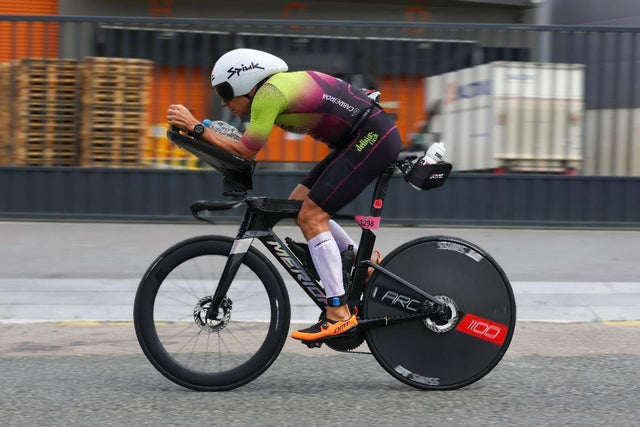
There is one phrase that comes up on every group ride as soon as someone gets down on the aerobars: "bring your elbows in". It is said with the best intentions and with logic that, on paper, is flawless: if the air is the enemy, the less body you offer it, the better. From there to assuming the narrowest position is always the fastest is a very short step, and almost everyone takes it.
The problem is that the phrase describes half the equation. The other half —the one that decides whether that position works for you or not— has to do with what happens in your body from minute fifteen onwards: how you breathe, how much core it takes to hold, how much room you have left to react to a bump and how many watts you can still push with your hips in that posture.
This article is about finding your width: the spacing between rests and between hands at which you are really fastest in your event, not the one that looks best in a side-on photo.

The gain is real and it isn't small. At the speeds ridden on the flat with aerobars, most of the resistance to overcome is aerodynamic, and the rider accounts for most of that drag: far more than the frame, wheels and helmet combined. Reducing the surface your body presents to the wind —the frontal area— is the biggest lever you have, and it's free: you don't have to buy anything, you just have to position yourself differently.
Bringing your elbows in does two things at once. The obvious one is narrowing your arms and shoulders. The less obvious one, and often the more rewarding, is that bringing the forearms together tends to lower and align the torso, so the air meets a cleaner shape up front. That is why, when someone narrows their position and gains speed, it isn't always just about width: it's about everything that gets rearranged with it.
So far, the group ride advice is right. What it lacks is a limit.
A very narrow position tends to bring the shoulders together in front and compress the rib cage just when the diaphragm needs space. At low intensities you don't notice. At threshold you do: breathing becomes shallow, the rate goes up and you get that feeling of never quite filling your chest. It is the worst possible place to save centimetres, because it affects the oxygen supply to the engine.
Hands close together massively reduce the lever arm you use to correct your steering. With the cockpit narrowed, a bump, an asphalt seam or a crosswind gust that catches you off guard turns into a movement that is much harder to contain. In a technical time trial on a circuit, or on any stretch with traffic and crosswinds, that loss of margin isn't theoretical.
This is the point that costs the most time and gets measured the least. A narrow position demands more core stabilisation work, and that work accumulates. When the muscles tire, the rider opens up, sits further back or simply comes off the aerobars. From that moment, the "fast" position set up in the garage is no longer in play: you are riding in another one, a worse one, without having chosen it.
In other words: a slightly less aggressive position you can hold for forty minutes almost always beats a perfect position you abandon after twelve. The honest comparison isn't between two positions, but between two complete races.
When you narrow and drop a lot, your hip angle closes with your torso. Beyond a certain point, that compression limits hip extension and penalises your ability to produce force. Aerodynamics doesn't automatically make up for that loss: if you give up sustainable watts to gain a few centimetres of frontal area, the balance can come out negative. And the worst part is that this balance doesn't show in the mirror, only on the clock.
Summed up in one sentence you can carry with you: fast isn't the narrowest position, it's the narrowest position you can hold for the whole event while breathing and putting out watts.
All three criteria go together. If one fails, the position is no good, however nice it looks from the front. And it is worth adding a fourth for real use on open roads: you have to be able to control the bike in it.
You don't need a lab to make a sensible decision. You need a method and a bit of patience.
Start with the rests roughly at shoulder width or slightly inside, with your hands relaxed. From there you narrow, never the other way round. It is much easier to gradually narrow a comfortable position than to rescue an impossible one.
Width, rest height and extension tilt all interact. If you change all three at once and notice an improvement, you won't know why; if it gets worse, you won't know either. One adjustment per session.
Choose a flat stretch without junctions, five to ten minutes long, and repeat it at the same perceived effort or the same heart rate, not the same speed. Speed is the result you want to measure; if you fix it in advance, you aren't measuring anything. If you have a power meter, even better: repeat at constant watts and compare average speed.
A position only makes the shortlist if you can hold it for twenty minutes straight without coming out of it, without shaking out your hands and without gasping for air. It isn't a magic number: it's the reasonable minimum to know whether you'll be able to use it in an event. If you sit up sooner, that position isn't yours yet; it may become yours with adaptation, but it isn't today.
Almost any new position feels strange for the first few days, and that strangeness doesn't mean it's wrong. Telling "I'm not used to it" from "this doesn't work for me" takes weeks of progressive work, not one ride. We cover it in the guide on how to get used to the aero position without paying the price.
| What you feel | Usual cause | Where to start |
|---|---|---|
| Short of breath at intensity, shallow breathing | Cockpit too narrow or torso compressed | Open the rests slightly before touching the height |
| The bike wobbles in crosswinds or over bumps | Hands too close together, little margin for correction | Widen the extension spacing and check your grip |
| You come out of position every few minutes | Core demand above your current level | Take a step back and adapt progressively |
| Watts drop compared with sitting up | Hip angle too closed | Raise the rests slightly or move the saddle position back |
| Sore or numb elbows and forearms | Support concentrated on very little surface | Check the pads and pressure distribution |
| Strained wrists, numb hands | Wrong extension angle | Adjust the tilt and rotation of the extensions |
The last two cases are the ones most often confused with a width problem, and they almost never are. If the tingling appears in your forearms and elbows, the issue is the support surface: we cover it in depth in the article on numb forearms and sore elbows in the aero position.
Once you know what position you want, the practical problem begins: getting the bike to give it to you. And this is where you notice the difference between aerobars made in sizes and aerobars made for you.
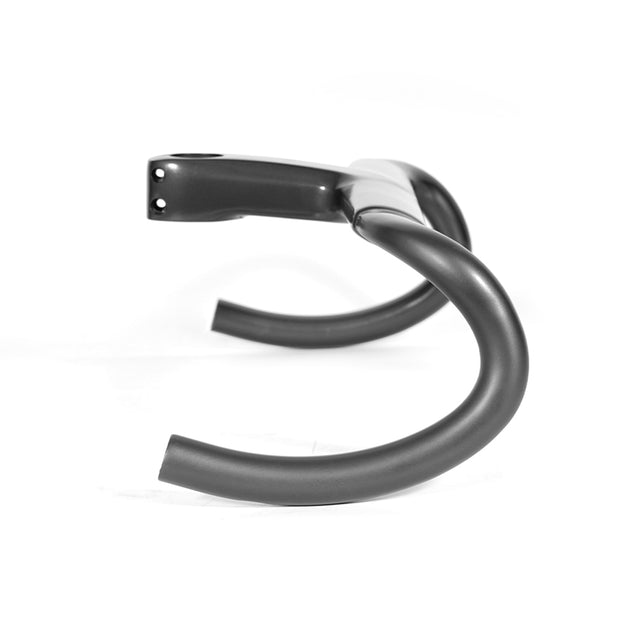
The CarboXtrem Custom Aero Aerobars are built from each rider's arm length and place the wrist at a 50º angle, which is where the hand works relaxed rather than strained. On top of that base, fine adjustment stays open: extension tilt is adjustable between 0 and 35°, height above the handlebar is precisely adjustable and the extensions themselves can be rotated towards the centre of the handlebar to narrow the position when the event calls for it. In other words: they don't force you to choose in advance between aggressive and sustainable, they let you move between both while you find yours.
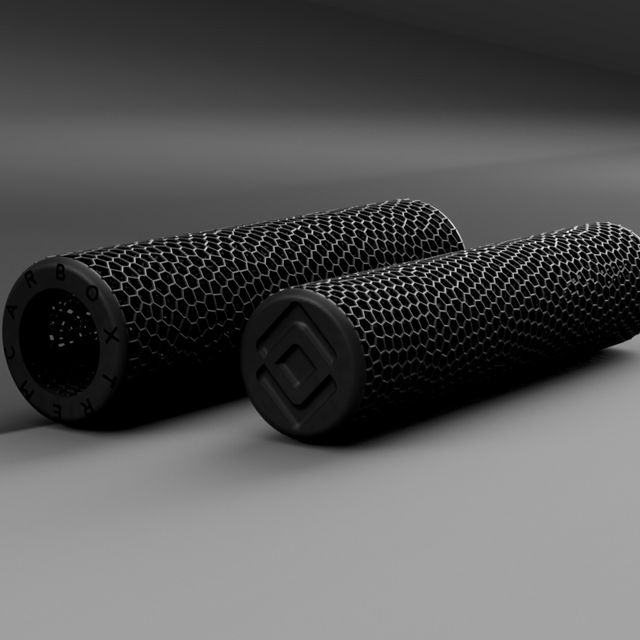
The structure is laid up by hand in carbon fibre, with stainless steel hardware, and the arm pads and grips are made in EPU 41, Carbon's elastomer known for how it handles vibration. That detail matters more than it seems in this context: the better the rest spreads the load from your forearms, the longer you can hold a narrow position before your body asks to come out of it. Width and rest comfort aren't separate topics; the second decides how long the first lasts.
If you are still deciding whether your path is clip-ons on your road bike or a complete time trial machine, we break down that comparison in time trial bike or road bike with aerobars. And if you are interested in how a cockpit is built from your measurements instead of a size, it's all in custom aero aerobars.
Copying a pro's position. An elite rider has spent years adapting their body to that posture and races specific events with that goal. Their width isn't a recommendation, it's the end of a very long process that started somewhere else.
Setting it up in the garage and never looking again. The position you can hold in March and the one you can hold in August aren't the same. Flexibility, training load and fitness change, and the cockpit should be reviewed along with them.
Testing at constant speed. It is the most common methodological mistake: going out to always ride at 35 km/h and comparing sensations. For the comparison to be worth anything you have to fix the effort and let speed be what responds.
Confusing aerodynamics with discomfort. A position that hurts isn't fast because of it. Pain is information: it usually means something is badly distributed, not that you are on the right track.
There is no universal measurement. The practical reference is the narrowest position you can hold for the whole event while breathing normally, controlling the bike and without losing watts. The usual approach is to start with spacing close to shoulder width and narrow it little by little, checking at each step that you can hold it for twenty minutes straight.
No. Narrowing reduces frontal area, which is the biggest source of drag, but beyond a certain point you pay for it with compromised breathing, less stability, less power and fewer minutes of sustained position. If you abandon the posture halfway through the event, the gain evaporates.
Running out of breath at intensity, coming off the aerobars every few minutes, feeling the bike unstable in crosswinds or seeing your watts drop compared with riding upright. If you notice any of those signs, open the position slightly before changing anything else.
Same flat stretch of five to ten minutes, same effort or same watts —never the same speed— and compare the average speed. One change per session, and be wary of very small differences: the wind adds more noise than you think.
It depends on the model. The CarboXtrem Custom Aero Aerobars are made to your arm length, with the wrist at 50º, and let you rotate the extensions towards the centre of the handlebar as well as adjust the tilt between 0 and 35° and the height. Many standard-size aerobars have a much shorter adjustment range.
That pain usually comes from the rest, not the width. When the forearm load is concentrated on a small surface, pressure rises and your body asks to come out of the position. 3D lattice pads with the right density spread that load better.
The width of your aero position isn't a number you copy from anyone or an adjustment you make once. It is the result of a negotiation between four things pulling in different directions —air, breathing, control and power— and that negotiation changes with your fitness, with the event ahead of you and with how long you have been riding in that posture.
If you're going to change something this week, start with the cheap part: ride your usual stretch, time yourself at your usual effort and check how many minutes you can really hold without coming off the aerobars. That number will tell you more than any group ride advice. And once you are clear about the position you want, see whether your equipment can give it to you: the CarboXtrem Custom Aero Aerobars are made to your measurements and with a lifetime warranty, precisely so your position doesn't depend on finding the size that comes closest to you.
Topics