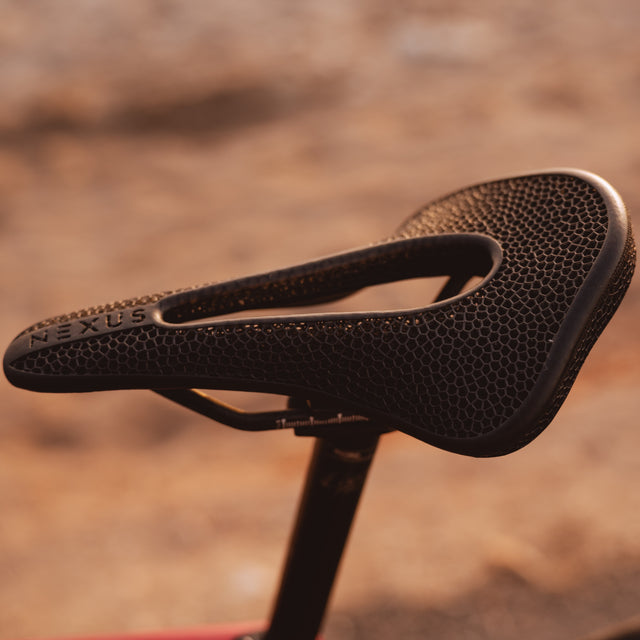
Fizik Adaptive, Specialized S-Works Mirror and Carboxtrem 3D Nexus have something in common:
- ✅ Manufacturing technology: Carbon DLS (Digital Light Synthesis)
- ✅ Material: EPU 41 (Elastomeric Polyurethane)
- ✅ Manufacturer: QDP.nl (Netherlands, Carbon Production Network)
So... why does a €220 Carboxtrem saddle objectively outperform a €250 Fizik or a €350 Specialized?
The answer lies in something you can't see: computational design.
THE CRITICAL DIFFERENCE
Carboxtrem uses 5,000+ control points with a strut thickness of 0.6mm
The competition uses ~2,000 points with a strut thickness of 1.0mm
Result: 2.5x higher design resolution + 40% finer geometries
💡 In short: It's like comparing a 1080p screen with a 4K one. Same display technology, different resolution. The level of detail and precision radically changes the final experience.
The Common Base: Same Technology, Same Material
Before explaining the differences, let's establish the objective facts about what these three saddles share:
| Element | Fizik Adaptive | Specialized Mirror | Carboxtrem 3D Nexus |
|---|---|---|---|
| Manufacturing technology | Carbon DLS SAME | Carbon DLS SAME | Carbon DLS SAME |
| Elastomer material | EPU 41 SAME | EPU 40/41 SIMILAR | EPU 41 SAME |
| Manufacturer | Asia | Asia | QDP.nl (NL) SAME |
| CLIP process | Yes SAME | Yes SAME | Yes SAME |
| Thermal post-cure | 120°C / 8h SAME | 120°C / 8h SAME | 120°C / 8h SAME |
| Biocompatibility certification | ISO 10993-10 SAME | Not specified | ISO 10993-10 SAME |
The obvious conclusion: If the technology base is identical, performance differences cannot come from manufacturing. They come from design.
The Real Difference: Sophistication of Computational Design
1. Control Point Density: 5,000 vs 2,000
What are control points in CAD design?
Control points define the three-dimensional geometry of the Voronoi lattice structure. Each point determines:
- Spatial position of a cell
- Size of the cell at that point
- Thickness of the surrounding walls
- Connections with adjacent cells
- Local mechanical properties
More points = Higher resolution = Finer control of mechanical properties
Competition (Fizik/Specialized)
Generic design for mass production. Optimised for 3-4 standard sizes.
Carboxtrem 3D Nexus
Per-user custom design. Each saddle is unique and specifically optimised.
Practical impact of 2.5x more points:
- Smoother gradients: Seamless transition between stiff zones (sit bone support) and flexible zones (perineal relief)
- Zone-by-zone optimisation: Each region of the saddle can have independent properties tuned to the millimetre
- Anatomical customisation: Exact adaptation to sit bone width (not "size M = 140mm", but "a specific 143.5mm")
- Superior pressure distribution: Enough resolution to eliminate load concentration points
2. Strut Thickness: 0.6mm vs 1.0mm
Strut thickness is the minimum wall thickness in the lattice structure. It determines which geometries can physically be manufactured.
| Feature | 1.0mm struts (Competition) | 0.6mm struts (Carboxtrem) |
|---|---|---|
| Geometry fineness | Limited to structures >1mm | ✅ 40% finer possible |
| Cell density | Maximum ~80 cells/dm³ | ✅ Up to 150 cells/dm³ |
| Ventilation channels | Thick (>2mm) | ✅ Intricate (<1mm possible) |
| Stiffness transitions | Abrupt | ✅ Smooth and progressive |
| Weight optimisation | Limited by minimum thickness | ✅ Aggressive reduction possible |
| Design complexity | Medium | ✅ High |
⚙️ Technical analogy: It's like the difference between printing with a 0.4mm nozzle vs a 0.2mm one in FDM. Same printer, different limits on what you can create. Finer struts allow geometries that are impossible with greater thickness.

3. FEA: Generic vs Personalised
FEA (Finite Element Analysis) is the computer simulation that predicts how the structure will behave under real loads.
| Aspect | Premium Competition | Carboxtrem |
|---|---|---|
| Analysis frequency | Once (master design) | ✅ For each individual user |
| Simulated load | Generic 75kg | ✅ User's specific weight (50-130kg) |
| Pressure distribution | Averaged | ✅ Based on actual sit bone width |
| Safety factors | 3-4x uniform (conservative) | ✅ Up to 10x calculated by zone |
| Discipline considered | Generic road/MTB | ✅ 6 specific disciplines |
| Optimisation iterations | 5-10 (master design) | ✅ 15-25 per user |
| Computation time | 1-2 weeks (once) | ✅ 20-40 hours per unit |
Why safety factors of up to 10x?
It isn't over-engineering. It's intelligent zone-by-zone calculation:
- Sit bone zone (support): SF 3-4x (constant load, needs stiffness)
- Perineal zone (relief): SF 8-10x (no load, maximise flexibility with no risk of failure)
- Side edges: SF 5-6x (abrasion and rubbing)
- Nose (front): SF 4-5x (dynamic loads on climbs)
This allows aggressive weight optimisation WITHOUT compromising strength where it matters.
4. Customisation: Sizes vs Millimetre-Precise
| Parameter | Fizik/Specialized | Carboxtrem |
|---|---|---|
| Sit bone width | 3-4 fixed sizes (S:130mm, M:140mm, L:150mm) |
WINNER Exact to the millimetre (110-170mm in 0.5mm increments) |
| Rider weight | Generic range 60-90kg | WINNER Optimised for a specific 50-130kg |
| Discipline | Generic road or MTB | WINNER 6 specialities: • Road • Gravel • MTB XC • Triathlon/TT • Ultra-endurance • Touring |
| Density zones | Uniform or 2 zones maximum | WINNER 5-7 differentiated zones |
| Pelvic flexibility | Ignored | WINNER Assessed and integrated |
| Pedalling style | Ignored | WINNER Optimised for seated vs out-of-the-saddle |
| Post-purchase modification | Impossible (fixed mould) | WINNER Version 2.0 at 50% off |
Final Assembly: The Spanish Factor 🇪🇸
Here is another fundamental difference that doesn't appear in technical specifications:
Complete Value Chain
| Stage | Fizik/Specialized | Carboxtrem |
|---|---|---|
| CAD design | Italy / USA | 🇪🇸 Spain (Carboxtrem team) |
| FEA | Italy / USA | 🇪🇸 Spain (in-house engineers) |
| DLS manufacturing | 🇨🇳 Probably Asia | 🇳🇱 Netherlands (QDP.nl) - SAME |
| Post-cure | 🇨🇳 Probably Asia | 🇳🇱 Netherlands (QDP.nl) - SAME |
| Final assembly | 🇨🇳 Probably Asia | 🇪🇸 Spain (by hand) |
| Final quality control | 🇨🇳 Asia (batches) | 🇪🇸 Spain (unit by unit) |
| Packaging | 🇨🇳 Asia | 🇪🇸 Spain |
| Distribution | Wholesalers → Shops | 🇪🇸 Direct to customer |
🇪🇸 Advantages of assembly in Spain:
- Full traceability: We know exactly who assembled your saddle, when and with which components
- Hands-on quality control: Visual and manual inspection of every unit, not statistical sampling
- Proximity: 24-48h express shipping within Spain vs weeks from Asia
- Direct technical support: You speak to the people who designed and assembled your component
- Local economy: Your purchase creates skilled jobs in Spain
Price Comparison: How Is It Possible?
Specialized
• EPU 40/41 material
• Firmness tuning
• Generic design
Fizik
• EPU 41 material
• 3 standard widths
• Generic design
Carboxtrem ✓
• EPU 41 material
• Total customisation
• 2.5x more sophisticated design
• Assembled in Spain
How Do We Achieve a Lower Price with Greater Sophistication?
Costs we DON'T have (the competition DOES):
- ❌ Multi-million sponsorships: Specialized and Fizik invest millions in WorldTour teams
- ❌ Mass advertising: TV campaigns, magazines, events = 6-7 figure budgets
- ❌ Distribution network: Wholesalers (15-20%) + Retailers (30-40%) = 45-60% of the retail price
- ❌ Physical shops: Rent, staff, inventory
- ❌ Warehoused stock: Capital tied up in thousands of units
- ❌ Inventory logistics: SKU management, demand forecasting
Where we DO invest (the competition can't justify it):
- ✅ 20-40 hours of CAD design for each individual unit
- ✅ Personalised FEA with the user's specific parameters
- ✅ Advanced CAD software: Rhinoceros, Grasshopper, nTop licences (€€€/year)
- ✅ Specialised engineers: Skilled Spanish salaries
- ✅ Biomechanical analysis: Time spent understanding specific needs
- ✅ Hand assembly: Spanish quality control unit by unit
💰 The secret: On-demand manufacturing + direct sales eliminate 50-60% of intermediate costs. We reinvest that saving in sophisticated computational design. Result: A similar or lower price with exponentially greater value.
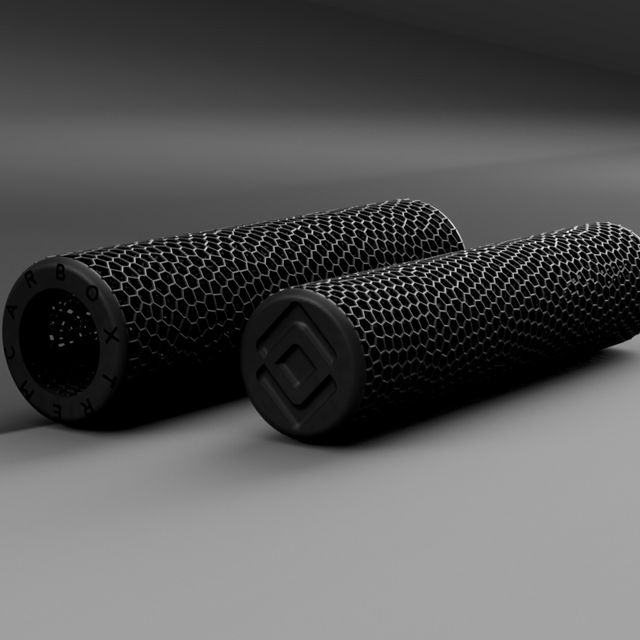
Bonus: Race Day Grips - A Special Case
Grips are the only product where our price (€75) is higher than basic alternatives (€30-45). Here the justification is different:
| Feature | ESI/Supacaz (€30-45) | Carboxtrem Race Day (€75) |
|---|---|---|
| Material | Foam / Silicone | EPU 41 (medically certified) |
| Biocompatibility | Not certified | ISO 10993-10 |
| Sweat/mud stains | Stain permanently | DON'T stain |
| Cleaning | Difficult (porous foam) | Water + soap (2 min) |
| Crash resistance | Foam tears easily | 25 kN/m (3-4x higher) |
| Installation | Difficult, needs compressed air | Easy (water, no tools) |
| Reuse | Damaged when removed | Reusable multiple times |
| Durability | 5,000-8,000 km | 15,000+ km |
| Weight (pair) | 45-60g | 22-30g |
| Customisation | 2 standard thicknesses | Unique made-to-measure ergonomics |
Cost per kilometre (what really matters):
- ESI Chunky (€30): €30 / 6,000 km = €0.50 per 100 km
- Supacaz (€45): €45 / 9,000 km = €0.50 per 100 km
- Carboxtrem (€75): €75 / 15,000 km = €0.50 per 100 km
Grips conclusion: Same cost per kilometre, but with the advantages of a superior material (biocompatible, stain-free, crash-resistant, reusable) + 40-50% lower weight + ergonomic customisation.
Arm Rests: A Product Unique in the World
🌍 UNIQUE IN THE WORLD
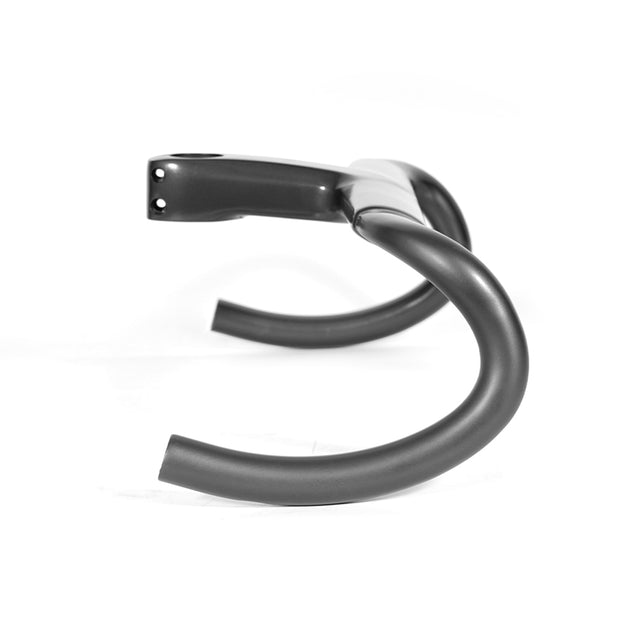
We are the ONLY manufacturers worldwide producing fully customised arm rests using Carbon DLS technology for carbon aero-flat handlebars of any brand.
Universal compatibility:
- Specialized Aerofly
- 3T Aeroghiotto
- Vision Metron
- Profile Design
- Zipp Vuka
- PRO Missile
- Any carbon aero-flat handlebar on the market
Price range: €220 (basic) - €440 (competition)
The difference between the basic and competition configurations includes features such as:
- Lattice structure complexity (cell density)
- Advanced aerodynamic optimisation
- Multi-layer differentiated cushioning zones
- Sensor/electronics integration (advanced models)
- Premium surface finish
Why is there no competition?
- Technical complexity: Every handlebar has a unique geometry. It requires 100% custom design.
- Insufficient volume: The triathlon/TT market is a niche. Big brands can't justify investing in specific moulds.
- Traditional manufacturing impossible: Complex adaptive geometries are only viable with DLS.
- Biomechanical analysis needed: It isn't just "adding foam"; it requires optimising support angle, weight distribution, etc.
See full configuration details at: CarboXtrem Aerobars

Testimonial: An Engineer Who Tried All Three
"I'm a software engineer and a cyclist who rides 12,000 km a year. I tried the three saddles mentioned, in this order:
1. Fizik Adaptive (€250): Excellent material, comfortable. But the 145mm size isn't my exact 143mm. An 'almost but not quite' feeling.
2. Specialized Mirror (€350): Impressive finish, visible technology. But the uniform firmness isn't ideal for my 68kg. Too stiff in areas where I need flexibility.
3. Carboxtrem 3D Nexus (€190 customised): This is where everything changed. EXACTLY my sit bone width (143mm). Soft zones where I need them (perineal), firm where I need them (sit bones). It's not 'a better saddle', it's 'MY saddle'.
The fascinating part: I analysed all three with a digital microscope. Identical material (EPU 41), same manufacturing technology (DLS). But the design resolution of the Carboxtrem is noticeably higher. Smaller cells, smoother transitions, evident zone-by-zone optimisation.
And on top of that it's €60-130 cheaper than the others. Carboxtrem's business model (sophisticated design + direct sales) works."
Frequently Asked Questions
They can't justify it economically at their scale. Fizik sells tens of thousands of saddles a year. They need to amortise design costs over mass production. Investing 20-40 hours of computational design in EACH unit is unfeasible when you produce 50,000 units a year. Their business model requires: 1 master design → 50,000 identical replicas. Our model: 1 unique design → 1 specific unit. They are fundamentally different philosophies. They optimise for scale, we optimise for customisation. Both approaches are valid for different markets.
Good question. The verification is in the CAD files we generate. Every customer receives (on request) a preview of the 3D model before manufacturing, in which they can literally count the control points using free software such as MeshLab or CloudCompare. What's more, the difference is visually obvious: compare macro photos of Fizik's Voronoi structure and Carboxtrem's side by side. The cell density and wall fineness are objectively greater on the Carboxtrem. It isn't something that can be faked - it's physically there in the manufactured part.
We keep your original CAD file in our system. If you change discipline (e.g. road to gravel), lose/gain significant weight, or your preferences evolve, we can create a version 2.0 of the component at 50% off, building on what we learned from version 1.0. We also offer a trade-in programme: you return the original component (we use it for R&D/testing) and get an additional discount on the new one. This flexibility is impossible with traditional moulded products.
It depends on volume. If you ride >5,000 km/year, the investment is justified by: 1) Sustained comfort on long rides (reduced fatigue), 2) Superior durability (amortisation per km), 3) Prevention of chronic discomfort (a real value, even if not monetisable). If you ride <3,000 km/year occasionally, a quality standard saddle is probably enough. It isn't about sporting level, but about accumulated hours in the saddle. An amateur touring cyclist who rides 10,000 km/year benefits more than a crit racer who rides 3,000 km/year.
Conclusion: The Small Company's Advantage
Fizik and Specialized are giants with endless resources. Multi-million budgets, teams of engineers, WorldTour sponsorships.
But they have a structural problem: they have to make thousands of identical units to amortise costs.
We make 1 unit: yours.
That's our competitive advantage:
- ✅ Same technology (Carbon DLS)
- ✅ Same material (EPU 41)
- ✅ Same manufacturer (QDP.nl)
- ✅ Lower price (€220 vs €250-350)
- ✅ 2.5x more sophisticated design (5,000 vs 2,000 points)
- ✅ 40% finer struts (0.6mm vs 1.0mm)
- ✅ Per-user FEA
- ✅ Hand assembly in Spain
The big players can make excellent generic products.
We small players can make excellent specific products.
That difference, in components in continuous contact with the body over thousands of kilometres, makes all the difference.
Ready to Try a 2.5x More Sophisticated Design?
30-day satisfaction guarantee • Assembled in Spain • Biomechanical analysis included
See Carboxtrem Products →Complete Series: Carboxtrem Technology
Questions about Computational Design?
Our engineering team can explain the technical differences in detail and help you decide whether customisation is right for you.