CarboXtrem TT Aerobars
€890,00
CARBOXTREM
Pre-launches, custom-fit tips and offers for your bike. No spam: only what is worth it.
Already have an account? Sign in09/09/2026 · Alfonso Lopez Pe

There's a feeling anyone who descends seriously knows: your forearms start doing their own thing. They don't exactly hurt, but they swell, lose precision and there comes a point where pulling the brake takes more effort than it should. You end up descending worse, and not for lack of legs or technique.
Almost everyone puts it down to force: "I squeezed too hard". And that's partly true. But the underlying cause isn't how much force you apply at any instant, but how many times per second you have to correct. A section of loose rock at moderate speed can put hundreds of small impacts per minute into your hands. None of them on its own is a problem. Added up over twenty minutes, they are.
This article is about exactly that: where that vibration comes from, why it wears you out, and what you can do to reduce it without going deaf to what the front wheel is telling you.
The front wheel is constantly reading the ground. Every root, every bit of gravel, every rock slab generates a movement that travels up the fork, into the handlebar and ends up in your hands. But not everything that comes up is the same, and this is the key to the whole thing.
These are the ones with travel: the step, the pothole, the wheel sinking into a sandy patch, the exact moment the tyre starts to slide in a loose dirt corner. This kind of movement is what tells you what's happening down there, and you feel it early enough to react. It's the useful part of the signal.
This is the fine, continuous vibration of broken surfaces, gravel, small-stone tracks and old tarmac. It gives you nothing you can use to ride: you're not going to correct your line for a two-centimetre stone. All it does is force your hand to keep a constant grip pressure so the handlebar doesn't move inside it.
The sensible goal, then, isn't "damp as much as possible". It's keeping the first signal and getting rid of the second. Everything you do to the cockpit should be measured against that criterion.
The muscles that close your fingers aren't in your hand: they're in your forearm, and they work by pulling on tendons. When you hold a firm grip for a long time, those muscles are contracted almost continuously and working inside a compartment that doesn't have much room to expand.
The result is well known: the forearm gets congested, you lose grip strength just when you need it most and the sensitivity in your fingers drops. In downhill and enduro it's called arm pump. In an XCO marathon it appears later and more discreetly, but it still appears.
The interesting part is what triggers that vicious circle: the less stable the grip feels in your hand, the harder you squeeze. And the harder you squeeze, the sooner you get pumped. That's why a grip that moves, slips or bounces tires you out far more than its weight or price would suggest. It isn't a comfort problem: it's an efficiency problem.
If you also notice tingling or areas of your hand going numb, then pressure on the nerves in the wrist channel comes into play, not just vibration; we cover it in numb hands on the bike.

Between the rock and your forearm there's a chain of elements, and each one soaks up part of the vibration. It's worth checking them in order, because the first ones are free and the last ones cost money.
It's by far the adjustment with the most impact and the one most people get wrong. A couple of tenths too much turns the tyre into a ball that sends back everything it receives. Going down until you find the limit (the point where you start to feel the rim on big rocks) and then going up a little changes the whole bike, not just your hands.
A heavily reinforced casing resists more punctures, but it's also stiffer and transmits more. If you ride fast, clean terrain, a tyre with lightweight sidewalls filters quite a lot better.
SAG and, above all, rebound. A fork with the rebound set too slow can't recover between hits on a section of continuous rock: it "packs down" and stops working just when it's needed most. It's a very common cause of battered hands that has nothing to do with grips.
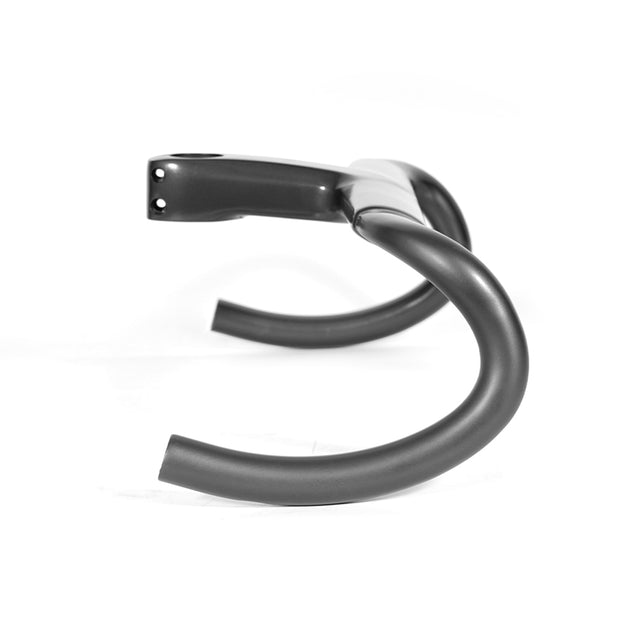
Material, width and geometry. A well-designed carbon handlebar damps better than an equivalent aluminium one, but the real effect of width and backsweep on wrist angle usually matters even more. A forced wrist grips worse and tires sooner.
The more weight you put on your hands, the more work they have to do. Raising the front end a few millimetres shifts load towards the back of the bike and takes weight off your arms without touching anything else.
The last link, the cheapest to change and the only one literally in contact with your skin. This is where it's decided how much grip pressure you need to feel that the handlebar is where it should be.
They help with friction and blisters, but a glove with thick gel does a poor job of solving the underlying problem: it adds a soft, dead layer between you and the bike, and usually worsens the feeling of control.
The instinctive reaction when your hands are suffering is to look for the fattest, squishiest grip in the catalogue. And it works, for half an hour: yes, you feel less vibration.
The problem comes later. A soft, solid material sinks under any load, and as it sinks it does two things you don't want. First, it also swallows the slow movements, the ones that warned you the wheel was about to go; without that warning you end up descending more slowly because you don't trust what's under you. Second, it forces your hand to close more to find something firm, so grip pressure rises and you're back where you started.
There's also a question of diameter: a grip that's too thick forces you to work with your hand wide open, which is exactly where you have the least grip strength. We cover it in detail in thin or thick grips?.
Put another way: softness and filtering aren't the same thing. What you're looking for isn't a surface that gives, but a structure that can tell the difference.
A conventional grip is a solid cylinder of rubber or silicone. Its behaviour is defined by the material: if the compound is soft, it gives easily everywhere and under any kind of load; if it's hard, it doesn't give anywhere. There isn't much room between those two options.
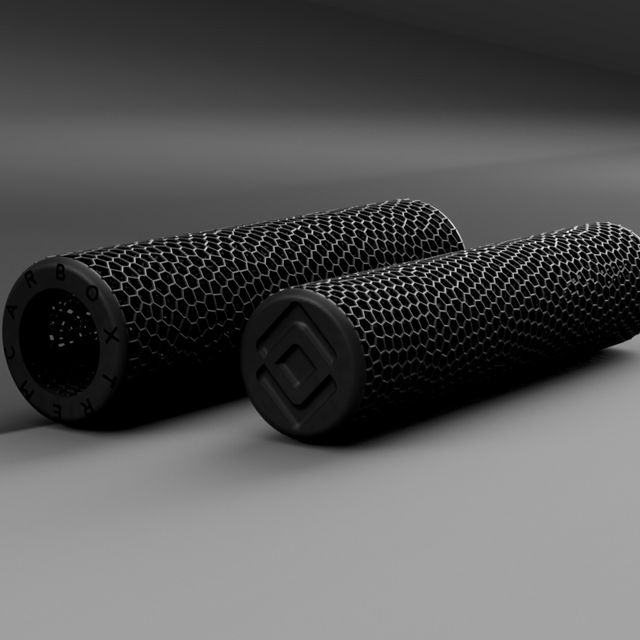
A 3D lattice grip works differently. It isn't a block of material: it's a three-dimensional network of thousands of cells with thin walls and air inside. And that difference has real consequences.
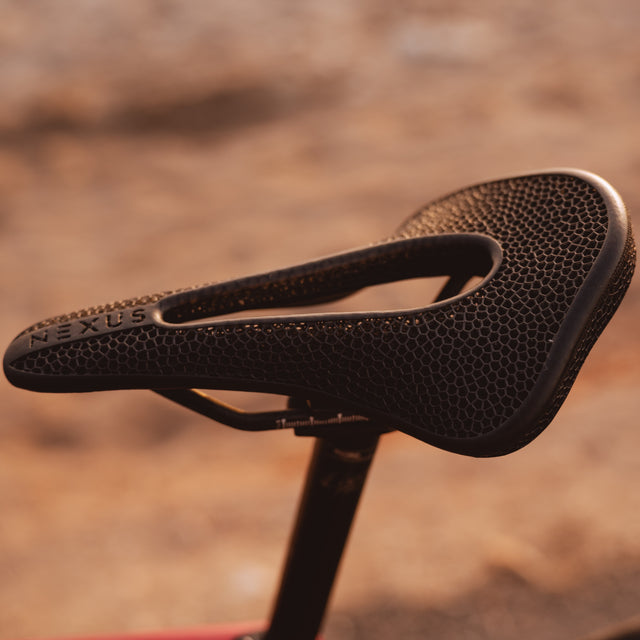
Race Day Grips are 3D printed in a single piece using Carbon DLS technology, in EPU 41, an elastomeric polyurethane from Carbon itself designed to work under fatigue without deforming. It's the same material and technology we use to make the lattices of the Carbon 3D NEXUS saddle, a component that takes considerably more punishment.
| Feature | Detail |
|---|---|
| Manufacturing | Single-piece 3D printing, Carbon DLS technology |
| Material | EPU 41 (Carbon's elastomeric polyurethane) |
| Structure | Three-dimensional open-cell lattice, with density tuned by zone |
| Grip | Structured surface that keeps its feel with sweat and moisture |
| Disciplines | XCO, marathon, trail, gravel with a flat handlebar |
| Price | €75 per set |
| Manufacturing | CarboXtrem design, made to order |
Before changing anything, it's worth making an honest diagnosis. These signs point to the grips:
And these point elsewhere: if the discomfort is in the wrist, look at handlebar width and angle; if you get battered mainly on sections of big, fast rock, check the fork rebound before anything else; if it appears with the bike barely moving, on long seated climbs, the problem is probably the cockpit's weight distribution. For that overall picture, the three contact points with the bike can help.
No, and that isn't the goal. A grip is the last link in a chain that also includes tyre pressure, casing, fork setup and handlebar. What a 3D lattice offers is filtering out the fine vibration that only tires you, while keeping the feel of the big movements, which are the ones you need to ride.
Because the muscles that close your fingers are in your forearm and work almost continuously when you hold a firm grip. Handlebar vibration forces you to grip harder, the muscle gets congested and you lose grip strength and sensitivity. It's the phenomenon known as arm pump.
Not necessarily. A soft, solid grip absorbs fine vibration, but it also erases information about the terrain and forces you to close your hand more to find firm support, which increases grip pressure. What works is a structure that responds progressively, not simply a softer material.
They're 3D printed in a single piece using Carbon DLS technology, in EPU 41, an elastomeric polyurethane from Carbon. It's the same material and process we use to make the lattices of the Carbon 3D NEXUS saddle.
Yes, as long as the bike has a flat handlebar. On gravel the vibration pattern is even more continuous than in MTB, because the broken surface is constant, so filtering out fine vibration is especially welcome on long rides.
Reducing handlebar vibration isn't about adding soft layers until you can no longer feel the ground. It's about checking the whole chain —pressure, tyre, fork, cockpit— and, finally, choosing a contact point that can keep what tires you out and let through what informs you.
That's exactly what we set out to do with Race Day Grips: that in the last hour you keep reading the terrain just as you did in the first.
Topics