CarboXtrem TT Aerobars
€890,00
CARBOXTREM
Pre-launches, custom-fit tips and offers for your bike. No spam: only what is worth it.
Already have an account? Sign in02/09/2026 · Alfonso Lopez Pe

There's a huge difference between riding in a group and riding alone, and it isn't just about company. In single file, the riders behind move inside the pocket the first one opens up. When you're on your own on an open stretch, you have to open that pocket yourself, and you do it with whatever goes first: the front wheel, the fork and, above all, the handlebar and stem assembly right in front of your chest.
That assembly is what we call the cockpit in the shop, and it's the area of the bike where the most small parts pile up per square centimetre. A large part of the conversation about the aero handlebar rests on those parts: what exactly it is, what a profile brings compared with a traditional round tube and when it makes sense to change it.

The word gets used very freely, so it's worth being specific. An aerodynamic handlebar isn't a prettier handlebar or a blacker one: it's a handlebar whose cross-section is no longer a circle.
A round tube has one huge virtue, which is that it resists well in every direction and is easy to make. Against the air, however, it's one of the least fortunate shapes: the flow sticks to the front half, can't follow the curve round the back and separates, leaving a turbulent zone behind it. That turbulent zone is drag.
The tops of a road handlebar can be forty centimetres long. Multiply that by two hours on a flat, windy stretch and you'll understand why manufacturers have spent years working on that section.
The alternative is a section stretched in the direction of travel: narrow seen from the front and long seen from above. The air enters over a rounded edge, runs along the surface and leaves over a sharper tail, without the abrupt separation of the round tube. It's the same idea behind a wing profile, applied to a part that also has to cope with you getting out of the saddle to pull on a ramp.
And here's the real design balance, which almost nobody talks about: the more you streamline the profile, the less material is left to resist torsion. A handlebar has to cope with you pulling on one end while pushing on the other. That's why the profile of a road handlebar is never as extreme as that of a time trial bar: it's a compromise between air and control.

This is where the conversation about aero handlebars usually falls short. You can fit the best-profiled wing on the market and still have a cluttered front end, because the wing is only one of the parts in front of you.
Take an inventory on your own bike, looking at it from the front:
Each of those elements creates its own wake, and several of those wakes interfere with each other. An integrated cockpit isn't magic: what it does is reduce the number of elements that are there. Bar and stem stop being two bolted parts and become one continuous body, the front bolts disappear from the front and the cables, if the build allows it, are no longer visible.
We have a whole article on that last point, because internal routing is as much about maintenance as looks: how internal cable routing works on an integrated handlebar.
At this point we'd be expected to quote a big number of watts saved. We're not going to, and it's worth explaining why.
Aerodynamic drag grows with the square of speed, so any figure depends directly on how fast you ride. A rider averaging 38 km/h on the flat isn't the same as one riding at 26. It also depends on wind direction, your clothing, your helmet and, above all, your posture: the rider's body is by far the largest exposed surface of the whole package. A number from a wind tunnel with a specific mannequin and a specific bike doesn't carry over to your Sunday ride.
The honest way to put it: you gain something in the cockpit, you gain more the faster you go, and you'll never feel it the way you feel a change of tyres or a new position. What you do notice from the first kilometre is something else, and it's in the next section.
When someone fits an integrated carbon handlebar after coming from a conventional setup, the first thing they mention is almost never the air. It's the feel.
A continuous body between the stem and the wings doesn't have a bolted interface in the middle that can give a fraction under hard braking from the hoods or when you get up to pull. Nor does it have a faceplate that can sit badly and start creaking after a month. The front end responds as one piece and drops off the list of suspects when the bike starts making a noise.
The other change is visual and there's no point pretending it doesn't matter: a cockpit without visible bolts or crossing cables is the difference between a bike that's been assembled and a bike that's finished.
A profile wider than it is tall has a pleasant side effect. The tops of the handlebar, the part you hold when climbing seated or riding easy, stop being a narrow tube and become a flat surface. That spreads your palm's support over a larger area instead of concentrating it on a line, something you'll appreciate from the third hour.
It's the same principle we apply to our other contact points and explain in the article on the three contact points on the bike: pressure is force divided by area, and it's almost always more effective to increase the area than to add padding.

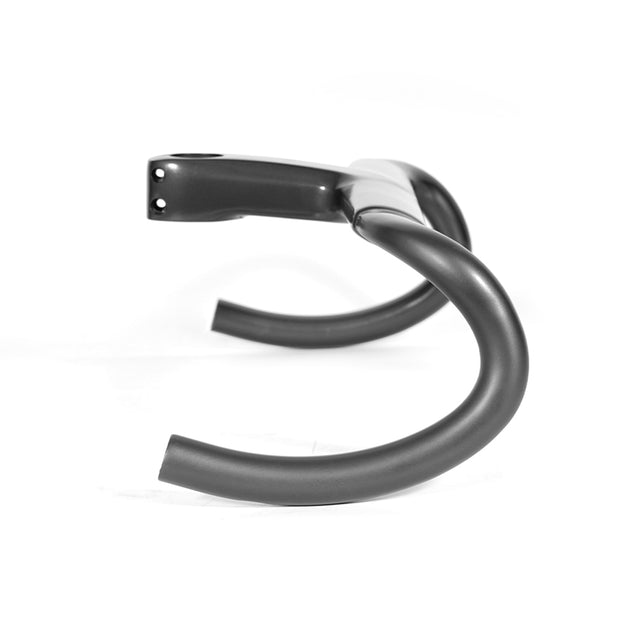
Our CarboX17 integrated handlebar applies everything above to a specific road part. These are its verifiable features, without embellishment:
| Feature | Detail |
|---|---|
| Type | Integrated handlebar: stem and bar in a single piece |
| Material | T1000-grade carbon fibre |
| Profile | Aerodynamic section on the top wing |
| Widths | 380, 400 and 420 mm |
| Stem lengths | 80, 90, 100, 110 and 120 mm |
| Combinations | 15 standard configurations |
| Cable routing | Compatible with internal and semi-internal routing |
| Accessories | Compatible with bike computer mounts |
| Discipline | Performance road and gravel |
The sizing part isn't a minor detail. An integrated cockpit is ordered with the width you already use and the stem length you already have fitted, because in a single piece those two dimensions can't be adjusted afterwards. If you're unsure which are yours, we cover it step by step in how to choose handlebar width and stem length.
A carbon handlebar isn't tightened by eye. There are two critical areas and both have a specified torque:
The first is the stem clamp on the steerer tube. The second is the lever clamps on the wings, which many riders overtighten "so they never move". With carbon, that doesn't make it safer, it makes it less safe. We explain the subject in detail in torque on carbon handlebars, and the practical summary is simple: torque wrench, the torque each manufacturer specifies and assembly paste where appropriate.
The second warning is about cutting. On an integrated cockpit, the fork steerer tube is cut to its final height and the spacers left underneath determine the final height. That job is done once. If you've never done it, now is the time to visit a workshop.
You'll see "T1000" on the spec sheet and it's worth understanding it properly: it isn't a brand name, it's a fibre quality grade. T700, T800 and T1000 describe different levels of stiffness and strength of the carbon fibre itself. We explain it fully in what T700, T800 and T1000 mean on a carbon spec sheet, because it's one of the most misunderstood figures when comparing components.
It depends on your speed, your posture and the wind, which is why we don't give a fixed figure. The aerodynamic gain from the cockpit is real but modest compared with that of body position, and it grows the faster you ride. What is immediate and noticeable is the increase in front-end stiffness.
Yes, as long as the chosen width suits your terrain. Gravel riders tend to go for slightly wider bars for control; if your size is within the available range, there's no technical obstacle.
Only within what the spacers you leave under the part allow once the steerer tube is cut. That's why it pays to have your position decided before fitting.
It's compatible with forks using the usual road standard, with internal or semi-internal routing depending on what your frame allows. If your bike has a proprietary steering system, it's worth checking first.
It's compatible with bike computer mounts, which is the clean solution: the device sits out front, aligned, without extra clamps on the wing.
An aero handlebar isn't a marketing label: it's a section that's no longer round so the air passes better. But the wing alone doesn't fix a cluttered front end. What really changes the package is reducing the number of parts, bolts and cables in front of your chest, and that's where an integrated cockpit does its job.
And if you spend much of your time riding alone, that front end is all yours the whole time. Nobody opens it up for you.
You can see the CarboX17 integrated handlebar with all its width and stem combinations in our shop.
Topics